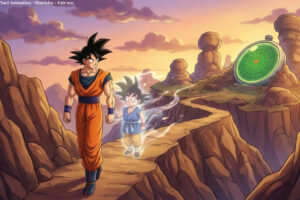
Dragon Ball has always been remembered for power transformations and legendary battles. Fans talk about Super Saiyan forms god ki and universe-shaking attacks. But the real damage in Dragon Ball rarely came from fists or energy blasts. It came from emotional wounds that appeared long before any character lost a fight.
Many of Dragon Ball most important characters were already broken on the inside before they were ever defeated on the battlefield. Their losses were emotional first. Physical defeat only made those wounds visible. This is the side of Dragon Ball that fans feel but rarely talk about.
Goku Was Broken the Moment He Learned What He Lost

Goku is often seen as carefree and joyful. He smiles in battle and treats danger like a game. But emotionally Goku carries loss from very early in his life.
He grew up without parents. He lost Grandpa Gohan before he even understood what death meant. He was raised alone without guidance or emotional stability. Goku learned to move forward because stopping would mean facing pain he did not know how to process.
By the time Goku becomes a warrior death is already normal to him. That is not strength. That is emotional numbness. When Goku sacrifices himself against Raditz he is not just protecting Earth. He is fulfilling a pattern he learned long ago. He believes his own life is expendable. That belief follows him through the Cell Games and beyond. Goku was emotionally defeated by loss long before any villain ever pushed him to his limit.
Vegeta Lost His Identity Before He Ever Lost a Battle

Vegeta’s story is not about power. It is about identity collapse. As a child Vegeta watched his planet destroyed and his people erased. He was forced to serve the man responsible for it. Every victory he achieved under Frieza’s rule was hollow. Pride became a mask he wore to survive humiliation.
By the time Vegeta arrives on Earth he is already broken. His obsession with strength is not ambition. It is desperation. He believes power is the only thing that can restore his stolen identity.
Vegeta’s emotional defeat happens on Namek when he realizes that everything he believed was a lie. His royal blood means nothing. His pride cannot protect him. His tears before Frieza are not weakness. They are release. Vegeta lost himself long before he ever lost a fight.
Gohan Was Damaged by Expectations Not Enemies

Gohan’s emotional damage is subtle but devastating. He never wanted to fight. He never wanted power. From childhood Gohan was forced into violence because adults believed he had potential. Every battle pushed him further away from who he truly was.
The Cell Games show this clearly. Gohan rage is not heroic. It is trauma erupting after years of pressure. When he finally snaps it is not victory. It is emotional collapse. Even after saving the world Gohan retreats from battle. Fans often criticize him for losing strength. In reality he is protecting himself from a role he never chose. Gohan was emotionally defeated by expectations long before any enemy touched him.
Future Trunks Was Living in Defeat Every Day

Future Trunks is one of Dragon Ball’s most tragic characters because his world never recovers. He grows up surrounded by death. His mentors die. His mother lives in constant fear. Hope becomes something rare and fragile. Trunks does not fight for glory. He fights because surrender means extinction. Every victory feels temporary. Every loss feels permanent.
When Future Trunks travels to the past he is already emotionally exhausted. He smiles but he does not rest. Even after defeating the Androids his world remains broken. His emotional defeat is not tied to one villain. It is tied to surviving too long in a world that never healed.
Piccolo Learned Pain Before He Learned Compassion

Piccolo begins as a villain but his emotional damage runs deeper than hatred. He is born from vengeance. He inherits memories of loss without understanding love. When Gohan enters his life Piccolo does not know how to protect someone without violence.
Piccolo’s sacrifice during the Saiyan Saga is not redemption. It is realization. He understands too late that he learned compassion through pain. Even after becoming a hero Piccolo remains isolated. He carries responsibility quietly. He expects no reward. He accepts loneliness as normal. Piccolo was emotionally defeated by his own origin long before his enemies tested him.
Why Emotional Defeat Matters More Than Power Loss

Dragon Ball often shows characters losing fights but the real losses happen earlier. Emotional defeat shapes decisions long before fists fly. Characters fight recklessly. Sacrifice themselves easily. Chase strength for the wrong reasons. These patterns come from unresolved pain. That is why some defeats feel hollow and some victories feel empty. The emotional battle was already lost.
Why Fans Feel These Stories So Strongly

Fans connect to these characters because emotional damage feels real. Power levels are fantasy. Pain is not. Loss of family. Loss of purpose. Pressure to succeed. Fear of failure. These are universal experiences. Dragon Ball works when it remembers this truth.
Dragon Ball Was Always About Healing Not Winning

At its core Dragon Ball is not about defeating villains. It is about surviving pain and choosing to move forward. Goku heals through connection. Vegeta heals through acceptance. Gohan heals through distance. Trunks heals through hope. Piccolo heals through quiet purpose. Not all healing looks the same.
Final Thoughts
The most powerful moments in Dragon Ball are not when characters transform. They are when characters confront who they have become because of loss. These warriors were emotionally broken long before they were defeated in battle. And that is why their stories still matter.
Dragon Ball’s Pattern: Break Them, Then Give Them One Person
Read the five stories above back to back and a pattern in the writing becomes hard to unsee. Dragon Ball almost never repairs its broken characters with a victory. It repairs them, when it repairs them at all, by giving them one person. Vegeta is the clearest example. No defeat of Frieza could have fixed what Frieza took from him, and no amount of training answered the question of who he was without a throne. What reached him instead was stubbornly ordinary: Bulma refusing to be impressed by him, and then Trunks, a son who gave the prince something to protect rather than something to prove. The healing was not an event. It was a household.
Gohan and Piccolo form the pattern’s most beautiful loop, because each became the other one’s person. Piccolo, born carrying a dead father’s hatred, was steadied by a child who trusted him without flinching. Gohan, crushed by expectations, was steadied right back by the mentor who understood pressure and never once asked him to enjoy fighting. Future Trunks is the tragic exception who proves the rule: everyone who could have been his person was already gone, and even saving the past could not rebuild the world that broke him. The modern era adds Broly, a man treated as a weapon his whole life, now being repaired the same old way — through Cheelai and Lemo’s plain friendship, and through Goku’s circle offering him meals, patience, and company instead of another battle.
The Damage That Never Fully Heals
Honesty matters here, because the series itself is honest about it: some of this damage never fully heals, and Dragon Ball is better for refusing to pretend otherwise. Vegeta’s guilt over his past is the standing example. The Moro arc makes it explicit. This is a man who travels to Namek not to fight for sport but to protect the very people he once terrorised, knowing that no apology can balance that ledger and asking for none. His pride survived. His innocence about himself did not, and the story never hands it back. He does not get to become a man who never did those things. He only gets to become a man who answers for them, one arc at a time, for the rest of his life.
Gohan carries the quieter version. His scholarly retreat as an adult is usually played for comedy — the great warrior lost to books and conferences — but read against his childhood it is also self-protection. A boy who was thrown at monsters before he was old enough to choose anything grew into a man who chooses a quiet life on purpose, and who still has to be dragged back whenever the world needs the version of him he never wanted to be. The series never waves a wand over that tension in him, just as it never erases what Trunks lost. The scars stay visible, and that restraint is exactly why these arcs still feel truthful decades later.
Why This Topic Hits Harder in 2026
There is a simple reason articles like this one land differently now than they would have in the 1990s: the audience grew up. Fans who first watched these characters as children are rewatching as adults with jobs, losses, parents aging, and children of their own, and life experience changes what a scene means. Vegeta holding his son used to read as a soft moment for a villain. Rewatched at thirty-five, it reads as the whole point — a broken man learning fatherhood in public, badly, then better. Gohan’s reluctance, once the fandom’s favorite complaint, now gets defended by viewers who recognize the cost of being the gifted child everyone else makes plans around.
The current era of the franchise quietly supports that reading. The Beerus era gave us an older, gentler cast: Vegeta the family man, Gohan the father and scholar, Piccolo practically a grandfather, whole episodes devoted to households rather than battlefields. Those domestic beats were once filler between fights. For the audience Dragon Ball has now, they are the emotional core, and the franchise’s quiet strength is how naturally it let its warriors age into fathers, mentors, and families without pretending the old wounds were never there. The fighting made these characters famous. Watching them carry what the fighting cost them is what makes them loved.
| Character | Breaking point | What (partly) healed them |
|---|---|---|
| Goku | Learning what he had lost: his parents gone, and Grandpa Gohan dead before he understood death | A found family of friends, and later a family of his own, that made loss survivable |
| Vegeta | Losing his planet, his title, and his identity under Frieza, then watching his beliefs collapse on Namek | Bulma and Trunks: a family that gave the prince something to protect instead of something to prove |
| Gohan | A childhood of expectations: forced into battles he never wanted, carrying pressure that was never his to carry | Piccolo’s steady presence, then his own family and the scholarly life he finally chose |
| Future Trunks | Growing up in a ruined world and losing his mentor, Gohan, to the androids | Very little: he carried hope to the past for others, but his own world stayed broken |
| Piccolo | Born from vengeance, carrying his father’s hatred before he had ever lived a life of his own | Gohan’s trust, and a battlefield sacrifice that turned an enemy into a guardian |