Dragon Ball is a series about training in the way other series are about fighting. The fights matter, of course, but they are mostly report cards. They tell the audience whether the quieter, stranger, harder work that came before them actually changed anybody. A new form is never just a new colour. At its best, it is proof that a lesson landed, that a body learned something a mouth could not explain, and that a character became someone slightly different from the person who started. That is the idea behind this look at dragon ball training arcs ranked from the franchise’s first small lessons to its ongoing lessons with a god.
In Dragon Ball, sweat is the series’ real currency. Villains arrive with power they were born with, stole, wished for or built in a laboratory. The heroes usually answer with time. Sometimes that time is three years under a guardian. Sometimes it is six frantic days inside a spaceship, a year inside a single day, or a childhood spent learning how to survive before learning how to punch. The cost is part of the result, which is why some modest arcs outrank training that produced far bigger numbers.
How We Ranked Them
Every arc here was judged by two tests. The first is what the training built: raw power, a lasting technique, control over something dangerous, or a change in character that stayed after the arc ended. The second is how well the training works as story. Does it have a clear teacher, a memorable place, a method we can understand and a cost we can feel? Does the montage do more than fill time between fights?
Those tests explain the surprises below. An arc that produced a huge power increase can still fall if it happened mostly off screen or taught its student nothing new about himself. A smaller arc can rise because its lesson became the template for everything after it. Teacher matters as much as trainee here, which is why readers may also enjoy our ranking of Goku’s teachers by what they taught him. With that in mind, we count down from the first real training arc in the franchise to the one we think does both jobs best.
9. Korin’s Tower
Korin’s Tower is the starting point, and in one sense it should be higher. This is the first real training arc of the franchise: young Goku climbs to meet a master who does not hand him a technique, a lecture or a shortcut. Instead, Korin turns the lesson into a chase for the sacred water, sending Goku after something he believes will make him stronger while the pursuit itself does the teaching.
What it produced was speed, sharper reading of an opponent and an early taste of humility. Goku learns to watch movement rather than simply charge at it, and to accept that effort can be the prize even when the promised reward is not what he imagined. As story, it is short, neat and quietly influential. The lesson hidden inside the exercise becomes the template every later master copies in some form. It ranks last only because its scale is small and its emotional stakes are modest beside the arcs that follow. It built the doorway, not yet the house.
8. Goku Under Kami and Mr. Popo
After Korin, Goku goes higher in every sense. His three years under Kami and Mr. Popo are the least flashy education on this list and possibly the most complete. The training includes weighted clothing, patience, awareness and the difficult separation of calm from power. Goku is no longer just a gifted child reacting faster than everyone else. He is being taught to remove wasted movement and wasted feeling from his fighting.
What it produced was the fighter who returned for the 23rd Budokai and won it, a boy becoming the world’s strongest the slow way. That matters because later Dragon Ball often compresses growth into days or hours. Here, growth still looks like schooling. The arc loses points as story because so much of it is glimpsed rather than lived through at length, and because Kami and Popo remain distant compared with later teachers. But as an education, it is beautifully complete: body, senses and temperament trained together.
7. Vegeta on Yardrat (Manga Only)
This entry needs its label up front: Vegeta’s training on Yardrat is, so far, manga-only material. That caveat affects its ranking, because anime viewers have not yet had the chance to live with this version of Vegeta in the same way. It does not, however, reduce what the arc does for him in the manga.
On Yardrat, the prince has to kneel, in spirit if not always literally, and learn from people he would once have dismissed as weak. Their Spirit Control training gives him greater balance and control, and eventually Forced Spirit Fission, a technique that can separate stolen or fused energy and which directly helps unmake the power Moro had taken from others. The bigger product is humility. This is training as character surgery. Vegeta does not simply add a move; he admits that Saiyan pride and raw force are not a complete education. That admission would have been unthinkable for the Vegeta who first came to Earth, and it is why this arc rises despite its manga-only reach.
6. Goku on King Kai’s Planet
King Kai gives Dragon Ball its first great afterlife classroom. Goku arrives dead, with a Saiyan invasion on a deadline, and has to adapt to a tiny planet where the gravity is ten times Earth’s. That ten-times gravity is the first great multiplier in the series, the moment training stops being only about skill and starts rewriting what a body can endure. Around that pressure, King Kai adds jokes, tests and the anime’s comedy tax in Bubbles and Gregory.
The results are enormous: the Kaioken and the Spirit Bomb, two techniques that defined early Dragon Ball Z and gave Goku answers that were dangerous as well as powerful. The Kaioken rewards timing and punishes greed, while the Spirit Bomb asks for help and patience rather than personal force. Together they suit the fighter Goku becomes when he is reading a battle as well as surviving it, a quality we explored in our ranking of Dragon Ball’s smartest fighters by fight IQ. As story, this arc also creates the lasting pattern: die or disappear, train with a god, return changed. It is foundational, even if later arcs deepen the pattern emotionally.
5. Vegeta’s Gravity Room Obsession
No training on this list is darker than Vegeta alone in the gravity room during the build-up to the Android conflict. There is no wise master, no friendship and no balance. There is a prince training in hundreds of times Earth’s gravity, pushing through exhaustion and injury, and measuring his worth against a rival who has pulled ahead of him and a transformation he believes is his birthright.
It produced Super Saiyan, but not through peace or understanding. Vegeta’s breakthrough comes after a breakdown, in a storm, screaming at the sky, when pride, grief and self-hatred finally break something open. That is the tragedy the story should not soften: the training worked, and its fuel was self-hatred. As a character study, it is unforgettable, because success does not heal him. It leaves him stronger, more arrogant and still incomplete. It ranks in the middle because its product is huge and its psychology is sharp, but as story it is deliberately narrow. It is one man, one room and one wound, repeated until the wound becomes a weapon.
4. Goku’s 100-Times Gravity Voyage to Namek
If you want self-designed training at its purest, this is it. While his friends face disaster on Namek, Goku turns his spaceship into a laboratory and a punishment chamber. He trains under rising gravity, up to 100 times Earth’s, in the middle of a journey that already has a ticking clock. Every session is therefore both preparation and gamble: arrive stronger, or arrive broken.
Carefully stated, the method was to push himself to the edge, heal, and go again. He repeatedly brought his body close to collapse, ate a senzu bean to recover, and used that recovery to build a body that could hold far more strain, including Kaioken at levels that would previously have destroyed him. Six days closed a gap of years. As story, it is superb economy. The training is a subplot, a race and a character statement at once. Goku does not wait to be taught here. He understands his own Saiyan recovery, his deadline and his limits well enough to turn a voyage into an arc, and he nearly pays for that confidence with his life.
3. The Room of Spirit and Time — Goku and Gohan
The Room of Spirit and Time, also called the Hyperbolic Time Chamber, sounds like a simple cheat: a year inside, a day outside. For Goku and Gohan, it becomes something smarter. The room gives them time, isolation and a harsh empty world, but the decisive lesson is not simply to suffer longer. Inside that year, they work toward making Super Saiyan feel normal rather than explosive.
What it produced was Super Saiyan Full Power, mastery over the form’s rage and drain, and the control that made Gohan’s later explosion at the Cell Games possible rather than accidental. Goku’s great insight here was rest as training. He chose full-power ease over chasing brute grades of the form, deciding that living calmly in the state would teach their bodies more than constant strain. Rest was not surrender. It was the technique. As story, the room also gives father and son a year of ordinary closeness inside an emergency, eating, resting and learning each other’s limits. It misses the top two only because the chamber itself returns later as a useful device, which slightly cheapens its first miracle, and because its greatest emotional payoff belongs partly to the next entry on this list.
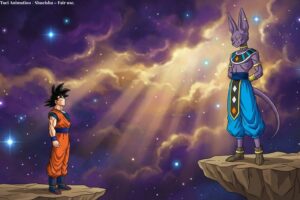
2. Training Under Whis
Whis is the funniest teacher in Dragon Ball and, by results, perhaps the most successful. From the Resurrection ‘F’ era onward, his training takes Goku and Vegeta out of the gravity-room mindset and into a god’s backyard, where the lessons arrive through a staff, chores, sparring, food and two rivals competing at homework neither wants to lose. The comedy is not decoration. It is how Whis keeps two proud fighters humble enough to learn.
What it produced was godhood in stages: access to godly power, Super Saiyan Blue, and the seed of Ultra Instinct. From the start, Whis teaches the value of letting the body move on its own rather than forcing every reaction through conscious thought. That idea takes years of story to flower, which is part of its strength. This is also, as of 2026, the only training on the list that is still running in spirit. Goku and Vegeta may leave, fight gods and monsters, and learn from others, but they keep returning to Whis because his classroom has no graduation. It ranks second, not first, because its open-ended nature means it does not yet have one complete emotional arc. It is a continuing education, brilliant and funny, still being written by every return visit.
1. Gohan’s Year in the Wilderness With Piccolo
The best training arc in Dragon Ball is not the one that produced the highest power level. It is the year Piccolo takes Gohan into the wilderness before the Saiyans arrive. Gohan begins as a sheltered, crying child who has been told, in effect, that the survival of the world now depends partly on him. Piccolo begins as his father’s enemy, a kidnapper calling it teaching, leaving a small boy alone among dinosaurs, hunger and weather with a sword and almost no comfort.
What it produced was first a survivor, then a fighter. Gohan learns to feed himself, endure loneliness, control fear and stand in a battle without freezing. Just as importantly, the training produces the series’ defining father-son bond, between a child and the man who did not have to love him. The montage is the emotion here. Small remembered details do the work that speeches cannot: dinosaur-era survival, the sword, the apple tree. That is why the apple tree matters more than the aura. A boy sharing food in a hard place tells us more about who these two are becoming than another power reading would. We returned to that bond from a different angle in our ranking of Dragon Ball’s best fathers, where Piccolo’s place needs no biological excuse. This remains the most human training on the list, and the one where both tests, what it built and how it reads, point to the same winner.
The Rankings at a Glance
| Rank | Training arc | Trainee & teacher | What it produced |
|---|---|---|---|
| 1 | Gohan’s year in the wilderness | Gohan & Piccolo | A fighter from a frightened child, and the series’ defining father-son bond |
| 2 | Training under Whis | Goku and Vegeta & Whis | Super Saiyan Blue, godly control and the seed of Ultra Instinct |
| 3 | The Room of Spirit and Time | Goku and Gohan, self-directed in the chamber | Super Saiyan Full Power and calm control of the form |
| 4 | 100-times gravity voyage to Namek | Goku, self-directed | A body able to sustain far higher Kaioken levels |
| 5 | Vegeta’s gravity room obsession | Vegeta, self-directed | Super Saiyan, reached through breakdown and self-hatred |
| 6 | Goku on King Kai’s planet | Goku & King Kai | Kaioken and the Spirit Bomb |
| 7 | Vegeta on Yardrat (manga only) | Vegeta & the Yardratians | Spirit Control and Forced Spirit Fission, plus humility |
| 8 | Goku under Kami and Mr. Popo | Goku & Kami and Mr. Popo | The 23rd Budokai champion and a complete, calm education |
| 9 | Korin’s Tower | Goku & Korin | Speed, reading an opponent and humility |
The Training the Series Is Still Trying to Repeat
For all the love the wilderness year deserves, the formula Dragon Ball keeps re-running most openly is Goku on King Kai’s planet. Remove the hero from the main board. Send him somewhere strange, preferably under a god or godlike teacher with a comedian’s timing. Hide the real lesson inside apparently silly tasks. Then bring him back with a technique that changes how the next fight has to be solved.
Whis is that formula scaled up, with better catering and a far deeper lesson. Yardrat repeats it for Vegeta, swapping jokes for discipline and forcing the student to admit another culture knows something he does not. Even the Room of Spirit and Time borrows part of it: leave the normal world, let time behave strangely, return as someone the enemy’s information no longer describes. Is that tribute or habit? It is tribute when the new teacher changes the student in a new way, as Whis and Yardrat do. It becomes habit when a series reaches for a remote place and a fresh multiplier because it needs power quickly and hopes the scenery will do the character work. Dragon Ball is at its best when it remembers the original King Kai lesson was never the planet. It was that Goku came back thinking differently, not only hitting harder.
Frequently Asked Questions
What is the best training arc in Dragon Ball?
We rank Gohan’s year in the wilderness with Piccolo first. It produced a capable fighter from a frightened child and created the Piccolo and Gohan bond, while also working as a complete emotional story on its own.
Why is training under Whis ranked so high?
Whis training produced Super Saiyan Blue and planted the idea behind Ultra Instinct, that the body should move on its own. It is also funny, ongoing and built around two rivals learning together, so it scores highly on both results and story.
What did Goku and Gohan learn in the Room of Spirit and Time?
They learned to stay in Super Saiyan with far less strain, reaching Super Saiyan Full Power. Goku’s key insight was that ease and rest inside the form taught them more than chasing stronger, harsher grades of it.
Is Vegeta’s Yardrat training in the anime?
So far, Vegeta’s Yardrat training, including Spirit Control and Forced Spirit Fission, is manga-only material. We have labelled it that way in the ranking so anime-only readers are not misled.
What was the first real training arc in Dragon Ball?
Korin’s Tower is the first real training arc on this list. Goku’s chase for the sacred water taught him speed, how to read movement and humility, and set the pattern of a lesson hidden inside an exercise.
What did Goku learn from King Kai?
From King Kai, Goku learned the Kaioken and how to gather and use the Spirit Bomb. Training in ten-times gravity also hardened his body, and the arc created the lasting pattern of leaving the world to train with a god and returning changed.