
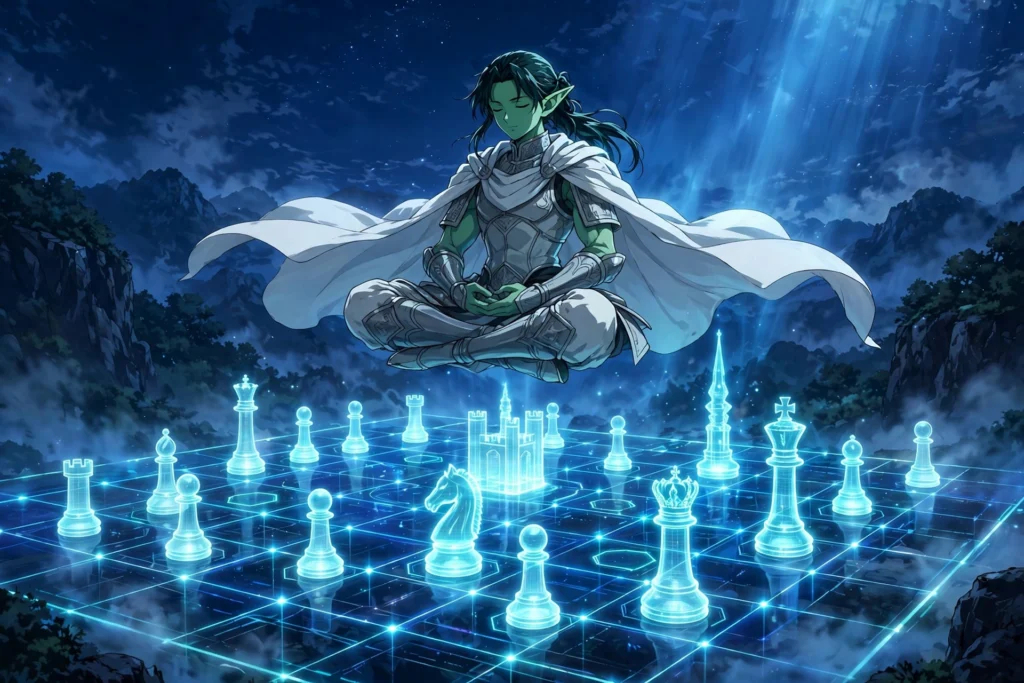
Every power ranking on this site measures the wrong organ for this question. The smartest Dragon Ball fighters ranked below earned their places in the seconds before a punch lands, not with the punch itself. Power rankings measure the fist. This ranking measures the few seconds before the fist moves.
That distinction changes everything. Our ranking of the strongest mortal in each of Dragon Ball’s 12 universes is a useful list, but strength settles a different argument. A fighter can be the strongest person in the room and still walk into a trap, waste a winning position, or solve a problem three exchanges too late. Fight IQ is what happens in the gap between seeing a problem and answering it.
So this list rewards the notice, not the noise: a weakness spotted, a rule remembered, a counter built while bleeding, a retreat chosen before it becomes a rout. And at the top, it forces an honest argument between the two minds the series keeps returning to — Goku, who learns faster than anyone alive once a fight starts, and Piccolo, who seems to understand the fight before it starts. We split them below, openly.
How We Ranked Them
Every fighter was judged on the same five fight-IQ tests, and only on what they do inside a fight:
- Reading opponents — spotting habits, weaknesses and intentions early enough to use them.
- Inventing counters on the fly — building an answer mid-fight, not bringing a rehearsed one.
- Adapting mid-battle — changing approach when the first plan dies, instead of repeating it harder.
- Using rules and terrain — treating ring-outs, time limits, stamina and the arena itself as weapons.
- Knowing when not to fight — stalling, retreating, sacrificing position or refusing a bad exchange to protect the larger win.
Raw power counts for nothing here, and we mean that literally. Winning an exchange because you were stronger earns no points on this list. Winning it because you saw something, timed something or tricked someone earns all of them. That is why some of the most powerful fighters in the series sit surprisingly low, and why a human with no transformation at all makes the cut.
Two honesty notes before we start. Evidence is labelled where it belongs to only one version — anime-only and manga-only feats are flagged in the text, because they do not always agree. And every entry below is anchored to at least one named fight. No one is ranked on reputation alone.
10. Cell — Data Is Not Wisdom
Cell begins this list because he is its warning label. Assembled from the cells of many of the greatest fighters of his era, he inherited their techniques and much of their knowledge — Cell had the library, but he never learned the lesson the library was for. Few villains have used borrowed knowledge better. During the Cell Games build-up he demonstrated Instant Transmission, a technique he had picked up in the course of the saga, and he designed the Cell Games themselves as engineered psychology: a ring, a waiting period and a public stage, all built to pressure Earth’s fighters into facing him on his terms.
Against Goku at the Cell Games, Cell fought a knowledgeable, varied fight, matching style for style. Then he threw away a position most fighters would kill for. Facing Gohan, Cell deliberately provoked the boy’s hidden power, tormenting him and his friends to force a stronger challenge — because a quick win bored him. He pushed Gohan past the point of control, into Super Saiyan 2, and lost everything for entertainment. A brain that chooses a better show over a finished fight has failed the last test on our list completely. Cell knew almost everything his opponents knew. He understood none of it when it mattered.
9. Krillin — A Weak Man’s Genius
Krillin has survived four decades in weight classes he does not belong in, and survival on that scale is not luck. It is invention. The Destructo Disc is a weak man’s genius in its purest form: a technique whose cutting power does not depend on Krillin being stronger than the person it is aimed at. Against Nappa in the Saiyan Saga it came within a moment of changing the fight, and against Frieza on Namek it took the tyrant’s tail — a permanent mark left by the weakest fighter on the field. The Solar Flare follows the same logic. If you cannot outfight the monster, blind it and move.
His Tournament of Power run (anime) showed the same mind working: he outlasted stronger fighters, combined with Android 18, and against the blind fighter Majora he read an opponent who tracked by scent and sound, then exploited the one sense Majora depended on most. The end has to be stated honestly, though. Krillin was eliminated by Frost (anime) after a lapse — a moment of relief and lowered guard that a sneak attack punished instantly. The lapse is real, and it keeps him at number nine. The invention is why he is on the list at all.
8. Frieza — The Emperor Out of Position
Frieza needs two scores and is only getting one. Outside the ring, he may be the smartest schemer in the series: he built and held an empire, manipulates allies and enemies alike, and his Tournament of Power bargain — fighting for Universe 7 in exchange for resurrection — was cold, correct calculation. None of that is scored here. This list ranks what he does inside a fight, and inside a fight Frieza has chronically wasted winning positions.
On Namek, against Goku, he held the advantage repeatedly and surrendered it to cruelty: drawing the fight out, transforming for spectacle and tormenting his opponents instead of finishing them, until delay produced the one outcome he feared. In his Golden Frieza rematch with Goku and Vegeta in Resurrection ‘F’, he repeated the pattern in a different key — arriving with a new form he had not stamina-tested, then fading in a fight he had controlled early. To his credit, Frieza diagnosed that flaw himself, and by the Tournament of Power era his calmer mental training showed in a far more disciplined final stand against Jiren. Growth noted. But ranked on the in-fight half only, an emperor sits this low, and the record is why.
7. Master Roshi — A Century of Patterns
Roshi’s advantage is a library nobody else on this list has had time to build: more than a century of watching fighters, and remembering how they fail. His signature move as a teacher has always been to deliver the lesson while fighting — at the 21st World Martial Arts Tournament, fighting in disguise as Jackie Chun against his own student Goku, he was reading a younger fighter’s habits in real time and correcting them mid-match, while making sure his pupils did not leave the tournament believing they had already arrived.
The Tournament of Power gave that old mind a modern test. Roshi’s Mafuba gambit — staking his own life on a sealing technique rather than on power he no longer had — is the clearest technique-over-muscle decision in the whole tournament: he knew exactly which fights he could not win and chose a tool that made winning them unnecessary. And in the manga (manga-only), against Jiren, Roshi briefly evaded a god-tier opponent through pure movement discipline, staying calm and letting his body answer without wasted thought. Whis’s commentary on that moment frames it as a shadow of Ultra Instinct’s principle — not the form, but the idea underneath it, practised by a man who had been teaching versions of it for a lifetime. His body caps him here. His pattern library is top-three material.
6. Gohan — The Scholar, Applied Late
Gohan forces an important distinction: book intelligence is not fight IQ. Gohan is the most educated fighter on this list by a distance, and for long stretches that education sat in a different room from his fighting. When the two finally connect, however, the results are special.
His best evidence comes from the manga (manga-only). In the manga’s Tournament of Power, Gohan eliminated Kefla — a fusion far beyond his comfortable weight class — by reading the fusion’s limits: its power came with a clock and a cost, and Gohan fought her to a planned mutual ring-out, trading his own elimination for the removal of a much larger threat. That is the fifth test on our list executed perfectly: he knew which fight not to finish. In Dragon Ball Super: Super Hero, against Gamma 1, the same Piccolo-trained battlefield calm showed again — he stayed composed, adapted as the android’s patterns revealed themselves, and never let a chaotic fight rush him. Why only sixth, then? Rust is an IQ tax. Gohan repeatedly lets his reads dull by not fighting at all, and a mind that needs warming up loses the opening exchanges that smarter, sharper fighters on this list would already have solved.
5. Hit — The Professional
Hit’s intelligence is a working assassin’s intelligence: economical, unsentimental and — this is his documented trait — improving during the fight itself. Against Goku in the Universe 6 tournament, his Time-Skip did not stay static while Goku studied it; it grew, extending and sharpening because the fight demanded it. Improvement mid-combat is usually the hero’s privilege in Dragon Ball. Hit does it as a matter of professional routine.
In his rematch with Goku (anime), Hit solved the problem of an opponent who had already countered him once, reinventing his approach with techniques Goku had never seen and fighting him to a standstill on new terms. Against Jiren in the Tournament of Power, he produced this list’s coldest piece of expected-value thinking: the time-cage gambit, trapping Jiren in slowed time at the edge of the arena. Hit built it knowing it would likely fail. It bought the two things that mattered more than his survival in the tournament — time for his team, and data on how Jiren answers a problem. An assassin’s economy runs through all of it: Hit never wastes a motion, a technique or a word, and he never fights for pride. The five fighters above him are the only ones who can match that discipline and add something to it.
4. Android 17 — The Best Defensive Mind on This List
Seventeen treats the arena like a coastline he has patrolled for years: he knows its edges, its weather and exactly how long everything in it can last. We rank him as the best defensive mind here, and the Tournament of Power is a full tournament of evidence. His barrier management protected teammates without draining his position. His stamina management was ruthless — in a format where fighters spent themselves in minutes, 17 paced himself like a man who had read the rules as a weapon, because for him they were: survival itself was a scoring condition, and he fought like it.
Against Anilaza, he was the fighter who found the giant’s weak point and acted on it while others were still measuring the problem. And in the final stand against Jiren, 17 coordinated with Goku, Vegeta and eventually Frieza, timed his barriers to other people’s attacks rather than his own, and — in the anime — even used an apparent self-destruction as a feint, re-entering a fight everyone believed he had left. A park ranger’s patience became a fighting style: protect the perimeter, waste nothing, and be the last one standing when the storm ends. He was.
3. Vegeta — Growth Is the Point
Vegeta’s pride made him slow to learn, which is exactly why his growth is the story. The young Vegeta was brute royalty: talented, experienced and convinced that birth had already answered every question a fight could ask. That Vegeta let problems grow for the sake of pride — most infamously standing aside in the Cell Saga while a larger threat assembled itself. His fight IQ is real today precisely because it was taxed by ego for so long, and both halves of that sentence matter.
In Dragon Ball Super, the analysis arrives. Against Jiren in the Tournament of Power, Vegeta read patterns in an opponent nobody else could touch, adapted his approach across the fight, and — crucially — stopped trying to copy Goku’s Ultra Instinct lesson, taking its underlying point his own way instead. That road leads, in the manga (manga-only), to Ultra Ego, and to something even more telling on Yardrat during the Moro arc (manga-only): Vegeta patiently learned Spirit Control from people his younger self would have dismissed, and the resulting technique, Forced Spirit Fission, solved Moro’s energy-absorption problem — a problem raw power could not touch at all. The prince who once solved everything by hitting it harder now studies, waits and picks the lock. Ego still interrupts him, and that interruption is the only reason he is third and not first.
2. Goku — The Purest Combat Learner Alive
Here is the argument, made openly. If fight IQ meant only what happens between the first exchange and the last, Goku would be number one, and it would not be close. He is the purest combat learner in the series. As a child he reproduced the Kamehameha after seeing Master Roshi perform it once, and that childhood party trick turned out to be his permanent method: watch, understand, answer. Our ranking of Goku’s teachers, ranked by what they taught him, is really a catalogue of how much he extracts from everyone who ever stood in front of him — including his opponents.
His signature case is Hit’s Time-Skip, solved twice in two different ways. In the Universe 6 tournament, Goku countered it with prediction, moving to where Hit’s attacks would arrive rather than reacting to where they had been. In the rematch (anime), facing an improved version, he answered with raw overflow, flooding the problem with power and speed until the skip could no longer contain him. Around those two answers sits a career of counters invented under pressure: biting opponents when his arms were trapped, Instant Transmission feints — including the famous bluffed Kamehameha against Cell that made a perfect fighter flinch — and, in the Tournament of Power against Jiren, a minefield of planted ki that turned empty arena floor into a trap. His weakness is that genius and recklessness are the same muscle in Goku. The curiosity that makes him learn an opponent also makes him feed that opponent rounds, senzu beans and second chances. In a single duel, nobody learns faster. Across a whole fight — before it, around it, and for everyone standing beside him — one fighter still edges him.
1. Piccolo — The Complete Package
Piccolo takes the top spot because he is the only fighter on this list who is elite at all five tests at once, including the two Goku routinely skips: planning before a fight, and thinking for the whole team during it. He is the series’ on-field coach, and his record starts at the beginning. Against Raditz, Piccolo devised the plan that killed a fighter neither he nor Goku could beat: Goku would hold Raditz in place, Piccolo would charge the Special Beam Cannon, and both of them understood what that hold would cost. It was a plan built from a clear read of everyone’s limits — including his own technique’s charging time and Raditz’s confidence that no one would sacrifice a partner.
From there, Piccolo’s intelligence kept widening. He diagnosed Gohan’s psychology for decades — reading the boy’s fear in the Saiyan Saga, building training around it, and at the Cell Games recognising, as Goku had not, that Gohan does not love fighting the way his father does. That understanding of a person is also why Piccolo anchors our ranking of Dragon Ball’s best fathers: he has been reading Gohan correctly since Gohan was four. Piccolo also treated knowledge itself as a weapon, fusing strategically — with Nail, gaining a warrior’s power and experience, and with Kami, gaining a god’s knowledge and perspective — choosing, both times, the merger the situation actually required. In the Tournament of Power he organised Universe 7’s teamwork, paired himself with Gohan to cover the team’s gaps, and read Frost’s treachery for what it was. One honest mark against him: his own loss to Frost came by trick — a concealed poison needle (anime) — not by being out-thought in open fighting, but he still paid for not expecting a hidden weapon. Even the best planner on this list can be cheated. He just cannot be out-planned for long.
| Rank | Fighter | Signature smart moment | What caps them |
|---|---|---|---|
| 1 | Piccolo | The Special Beam Cannon plan against Raditz | A hidden trick, like Frost’s needle, can still catch him |
| 2 | Goku | Predicting Hit’s Time-Skip in the Universe 6 tournament | Recklessness gives opponents rounds and second chances |
| 3 | Vegeta | Forced Spirit Fission against Moro (manga) | Ego still interrupts the plan |
| 4 | Android 17 | Coordinating the final stand against Jiren | Supreme defence, fewer fight-changing inventions |
| 5 | Hit | The time-cage gambit against Jiren | His best plans buy time more often than they finish elite foes |
| 6 | Gohan | The mutual ring-out against Kefla (manga) | Rust dulls his reads between fights |
| 7 | Master Roshi | The Mafuba gambit in the Tournament of Power | Age, stamina and a body that cannot cash his reads |
| 8 | Frieza | Fixing his Golden form’s stamina flaw by the Tournament of Power era | Cruelty wastes winning positions, as on Namek |
| 9 | Krillin | The Destructo Disc against Frieza on Namek | One lapse of attention ended his Tournament of Power |
| 10 | Cell | The Cell Games as engineered psychology | He provoked Gohan for entertainment and lost a won fight |
The Brain the Series Trusts Most
Ask a different question — not who learns fastest, but who the other fighters look at when a plan is needed — and the series answers it the same way, again and again. They look at Piccolo. Goku is the fighter everyone trusts to solve the exchange in front of him. Piccolo is the fighter they trust to understand the whole situation: who is tired, who is lying, which opponent matters, which teammate is about to make a mistake, and what the fight will look like in ten minutes if nobody changes it now.
That is why he coaches from inside the roster in the Tournament of Power, why Gohan’s entire fighting education runs through him, and why his read of a situation so often becomes the team’s read a moment later. Goku’s genius is a flame. Piccolo’s is a map. In a one-on-one duel the flame might win the argument — but across Dragon Ball’s whole history, the map is the brain the series itself trusts most, and it is the brain we are ranking first.
Frequently Asked Questions
What is fight IQ in Dragon Ball?
Fight IQ is everything a fighter does with information during a fight: reading an opponent, inventing counters, adapting when a plan fails, using rules and terrain, and knowing when not to fight. It is deliberately separate from power, which is why this ranking looks so different from a strength ranking.
Why is Piccolo ranked above Goku if Goku learns faster?
Because this list scores the complete fight, not only the exchanges inside it. Goku is the fastest in-fight learner in the series, and we say so in his entry. Piccolo matches a high level of in-fight reading with planning, team organisation and people-reading that Goku rarely attempts, which makes him the more complete fight brain.
Why is Frieza ranked so low if he runs an empire?
Because empire-building is scored nowhere on this list. Frieza’s scheming, manipulation and bargaining are elite, but the ranking covers only what he does inside a fight — and there he repeatedly wasted winning positions, on Namek and again with Golden Frieza’s stamina blunder in Resurrection ‘F’.
Why is Gohan not higher, given his intelligence and potential?
Book intelligence is not fight IQ, and Gohan’s own career proves the difference. His best fight thinking — the Kefla ring-out plan in the manga and his composure against Gamma 1 — is top-tier, but long periods away from fighting dull his reads. Inconsistency, not ability, holds him at sixth.
Do anime and manga feats count the same way here?
They are both used, but they are not blended silently. Where a feat exists in only one version, the entry labels it anime-only or manga-only — Roshi against Jiren and Gohan against Kefla are manga evidence, while Krillin’s and Piccolo’s encounters with Frost are anime evidence.
Who just missed this list?
Tien is the closest miss. Holding Semi-Perfect Cell in place with repeated Tri-Beam attacks was a perfect piece of fight IQ — technique, positioning and self-sacrifice buying time he had no power-based right to buy. Future Trunks also deserves a mention for repeatedly fighting to change outcomes rather than to win exchanges. On a list of eleven, Tien is eleventh.


Pingback: 9 Techniques That Changed Dragon Ball
Pingback: Dragon Ball's Strongest Humans, Ranked