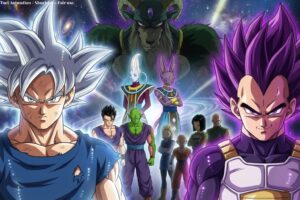
Power levels get the posters. Transformations get the toys and the trailers. Techniques, though, are the quiet part of Dragon Ball that actually writes the rules. This ranking of dragon ball techniques that changed the series starts from that idea: when a new technique appears and works, the story around it cannot go back to what it was before. Geography stops mattering, or death stops meaning what it meant, or two heroes stop adding up the way arithmetic says they should.
That is why this is not a list of the strongest attacks, the loudest finishes or the moves we would most want on a T-shirt. Some entries here rarely win a fight outright. One of them has an openly losing record. Another is mostly used to get somebody to a fight rather than to settle it. All nine changed what kind of Dragon Ball story could be told next — and once you notice that, you start seeing their fingerprints on arcs that never even name them.
How We Ranked Them
Every technique was judged on one test: how permanently did it change the rules of the series? In practice that meant asking three follow-up questions. What stories became possible after it existed? What stories became impossible, or at least much harder to tell honestly? And did later arcs have to keep obeying the new rule, work around it, or invent limits to stop it ending every plot in five minutes?
Raw power, popularity and screen time were only tiebreakers. A technique ranks high here if the series could never quietly uninvent it. Two honesty notes apply throughout. Dialogue and scenes are paraphrased briefly rather than quoted, and where a technique’s rules were later clarified or adjusted — especially in Dragon Ball Super — we say so in general terms instead of pretending the first explanation was the final one. Where anime and manga versions differ in a way that matters, that difference is labelled.
9. Destructo Disc (Kienzan) — The Equalizer
Krillin’s Destructo Disc is a flattened, spinning blade of ki that cuts through almost anything, and the important part was never the shape. It was who was throwing it. On Namek, Krillin’s disc sliced off part of second-form Frieza’s tail and forced the tyrant to take him seriously for a moment. In an era when the power ladder was supposed to decide everything in advance, a fighter far below Frieza had produced an attack Frieza could not simply tank and ignore.
The rule it changed sounds small and is not: technique can trump the power ladder. A precise, well-designed attack can threaten someone the user could never out-wrestle, out-last or out-beam. That loophole is the foundation this site keeps returning to — it is the same principle behind our ranking of Dragon Ball’s smartest fighters, where reading a fight matters more than winning a measuring contest. The disc ranks last here only because the series often contains its own loophole, letting stronger villains dodge, regenerate or learn after the first warning. The principle, once shown, could never be unshown.
8. Kaioken — The Multiplier Template
Kaio-ken, taught to Goku by King Kai, multiplies the user’s power for short bursts while straining the body that has to carry the output. Its debut against Vegeta mattered less for the numbers than for the bargain underneath them. For the first time, power in Dragon Ball was a risk calculation: how much extra output do you buy, for how long, and what does your body pay when the bill arrives? A body traded for output is a very different story engine from a fighter simply being stronger.
Every later negotiation with power descends from that bargain. The punishing grades of Super Saiyan, the stamina problems of new god forms, the careful stacking of techniques in Super — all of them ask Kaioken’s question in a new costume. Even Goku’s later decision to combine Kaioken with Super Saiyan Blue (anime) is less a comeback than an admission that the old template still fits. Kaioken is obsolete as a front-line tool against modern opponents, and immortal as an idea. Before it, strength was what you had. After it, strength was also what you dared to spend.
7. Mafuba (Evil Containment Wave) — The Sealing Answer
The Mafuba was created for an enemy who could not be beaten in a straight fight. Master Roshi’s own master, Mutaito, used it to seal Demon King Piccolo away, and classically the technique costs the user their life in the attempt. Roshi himself dies trying to repeat it when Piccolo returns. That cost is the point: sealing is not a shortcut around a stronger villain, it is a desperate exchange — one life, spent correctly, to put an unbeatable problem inside a container instead of a grave.
Its rule change widened what victory could look like. A fight could now be won with preparation, a vessel and a seal rather than a bigger punch, which quietly gave older and weaker fighters a terrifying relevance. Dragon Ball Super proved the rule still held. Against Zamasu, the heroes turned back to the Mafuba — and the attempt collapsed into tragicomedy because a crucial sealing talisman had been forgotten. A god-era villain, a plan built on an old master’s technique, and a failure caused by paperwork: the Mafuba’s return showed that new gods are still governed by old rules if you use them properly.
6. Hakai — Deletion, Not Death
Hakai is the destroyers’ erasure technique, associated above all with Beerus and the other Gods of Destruction. Ordinary killing in Dragon Ball exists inside a system: souls travel to an afterlife, judgement happens, and the Dragon Balls can sometimes reverse the whole transaction. As the story presents it in general terms, a being destroyed by Hakai does not simply move through that familiar death-and-afterlife process in the same way. Hakai is deletion presented as a divine function, not a murder with extra force behind it.
That changed what killing means in a series famous for softening death. Resurrection had already lowered the stakes of dying; Hakai raised a different kind of terror, one aimed at permanence. It also hangs quietly over almost every relaxed Beerus scene since his introduction — the comedy of a sleepy, food-obsessed god works because everyone in the room knows what he can do when he stops being amused. Hakai ranks sixth rather than higher because the series uses it sparingly and keeps its edges deliberately godly and vague. As a threat that rewrites the safety net, though, few techniques cast a longer shadow per use.
5. Spirit Bomb — The People’s Weapon
The Spirit Bomb, taught by King Kai, gathers energy offered by living things — and in its largest uses, by people who choose to raise their hands and give. It is the only major technique in Dragon Ball powered by consent. The user cannot simply take the energy the way a villain drains a planet. He has to ask, wait and trust that everyone else will answer, which makes the Spirit Bomb less a weapon Goku owns than a vote the world casts.
The honest record makes that point better than hype could. The Spirit Bomb wounded Vegeta in the Saiyan saga but did not finish him. Against Frieza on Namek, even a huge Spirit Bomb failed to end the fight. Its one perfect win came in the Buu finale, when energy gathered from Earth and beyond finally destroyed Kid Buu for good. So the record is a losing record plus a single, total victory — and that is exactly why it matters. The Spirit Bomb works when the story is about everyone, not just the strongest person present. After Buu, every Dragon Ball finale carries a quiet question the Spirit Bomb introduced: who else gets to help save the world?
4. Ultra Instinct — The Ceiling Moved From Power to State
Ultra Instinct is the angels’ technique: the body reacts, dodges and strikes without the delay of conscious thought. It is not a transformation you buy with rage, grief or a new level of screaming. It is a discipline you approach by surrendering thought — which is why it has always fit Goku strangely and perfectly at once. A fighter who learns by instinct finally met a technique that asked him to stop narrating the fight to himself and simply be in it.
Its rule change is philosophical before it is physical. For decades, strongest in Dragon Ball mostly meant a bigger number, a new colour and a larger aura. Ultra Instinct moved the ceiling from power to state: clarity, separation of thought and movement, mastery rather than accumulation. It gave Goku a finish line that is not just the next multiplier, and gave the current era a top end that feels earned through temperament rather than purchased through anger. The anime and manga develop and display it differently in detail, but the core rule is shared. It ranks fourth because its revolution, so far, belongs mainly to Goku and the angels — profound, but narrower than the three rules above it.
3. Kamehameha — The Signature
Start with the most famous scene of learning in the whole franchise. The Kamehameha was Master Roshi’s signature technique, said to have taken him fifty years to develop. Young Goku then reproduced it moments after seeing it once — imperfectly, joyfully, and well enough to announce the series’ whole talent thesis in a single gag that is not really a gag. In Dragon Ball, mastery is heritage, teaching and tradition — and then a gifted child arrives who absorbs in an afternoon what a master built across a lifetime.
From there, the Kamehameha became the franchise’s grammar. It is nearly every finale’s punctuation, the beam struggle readers measure other beam struggles against, and a technique inherited and reinvented by every generation: Gohan’s versions, young Goten’s gleeful attempts, and the father-son Kamehameha that closed the Cell Games with Gohan walking forward through his father’s encouragement. If you want to see how often it ends an era, work through our ranking of every Dragon Ball saga finale and count. It ranks third, not first, for an honest reason: it changed how Dragon Ball expresses its endings even more than it changed what stories were possible. Expression matters enormously. It is just a slightly smaller rule than the two above it.
2. Fusion — The Math-Breaker
Fusion earns one entry with two forms. The Fusion Dance, learned from the Metamorans, requires two matched fighters to perform a precise, frankly ridiculous dance; get it wrong and the result is a flawed fighter who must wait out the clock. Potara fusion uses the Kai’s earrings instead, and was first presented as the grander, more permanent option — though its rules were later clarified and adjusted in Dragon Ball Super, particularly around how long it lasts for non-Kai users. Both forms do the same revolutionary thing: two fighters become a third person, with a new personality, new confidence and power that is not a simple sum.
From the Buu saga onward, that rewrote every endgame calculation. Vegito, Gotenks, Gogeta, Kefla and Fused Zamasu all exist because fusion let a story answer an unbeatable villain by changing who the protagonist temporarily was. It created the fandom’s favourite accounting game — which pair, which form, how long is left — and it forced the series to invent and adjust limits on time, power and the earrings themselves to keep tension alive. If you want every result scored, see our ranking of every Dragon Ball fusion. Fusion ranks second because no other technique so completely broke the roster maths: after fusion, one plus one could be a warning siren.
1. Instant Transmission — The Logistics-Killer
Goku learned Instant Transmission on Yardrat while finding his way home after Namek, and it is the most consequential technique nobody puts on posters. By sensing a ki signature and moving to it instantly, he quietly abolished distance — and distance had been one of Dragon Ball’s oldest storytellers. Journeys, races against time, being stranded on a dying planet, arriving too late because the journey was too long: whole categories of story simply stopped working the moment Goku could fold the map in half.
What replaced them was just as important. The rescue arrival became a signature beat — a hand on a shoulder, a villain’s punch suddenly hitting empty air. Training commutes to gods became plausible. Evacuations became split-second decisions. And Instant Transmission enabled one of the series’ defining sacrifices: with Cell about to detonate and destroy Earth, Goku used it to carry Cell to King Kai’s planet instead, trading his own life for the planet’s survival. Its one honest limit — needing a ki signature to lock onto — is what keeps any tension alive at all. Remove the Kamehameha and Dragon Ball loses its voice. Remove Instant Transmission and modern Dragon Ball loses its roads, its timing and half its plots.
Summary: The Rules Each Technique Changed
| Rank | Technique | First era | The rule it changed |
|---|---|---|---|
| 1 | Instant Transmission | Dragon Ball Z, after Namek | Distance stopped deciding who could arrive, escape or be rescued |
| 2 | Fusion | Dragon Ball Z, Buu era | Two fighters could become a third, rewriting endgame power maths |
| 3 | Kamehameha | Dragon Ball | A learned beam became the shared language of the finale |
| 4 | Ultra Instinct | Dragon Ball Super | Strength stopped being only a number and became a state |
| 5 | Spirit Bomb | Dragon Ball Z, Saiyan era | A battle could be decided by energy freely given by others |
| 6 | Hakai | Dragon Ball Super | Erasure bypassed the familiar death-and-afterlife safety net |
| 7 | Mafuba | Dragon Ball | An unbeatable enemy could be sealed instead of defeated, at a cost |
| 8 | Kaioken | Dragon Ball Z, Saiyan era | Power became a bargain that traded the body for output |
| 9 | Destructo Disc | Dragon Ball Z, Saiyan and Namek eras | A precise technique could threaten fighters far above its user |
The Technique the Series Quietly Cannot Live Without
Our verdict is the technique we ranked first: Instant Transmission. The test is subtraction. Take away the Kamehameha and Dragon Ball still has beams, finishers and finales — it has lost its signature, not its skeleton. Take away fusion and the Buu-era endgame needs a new answer, but earlier and later arcs mostly stand. Take away Instant Transmission and the series has to rebuild its day-to-day plotting from the ground up: how Goku reaches a crisis, how anyone escapes one, how training with distant gods fits between emergencies, how Cell’s detonation becomes a sacrifice instead of an extinction.
That is the mark of the deepest rule change on this list. The loud techniques decide who wins a fight. Instant Transmission decides whether the fight can happen where it happens, when it happens, and who is still alive afterwards to talk about it. It turned a technique learned off-screen, on a planet many readers never think about, into the connective tissue of modern Dragon Ball. The series can live without any single attack. It quietly cannot live without its roads — and Instant Transmission is the road.
Frequently Asked Questions
What is the most important technique in Dragon Ball?
By the rules test used here, Instant Transmission. The Kamehameha is the most iconic technique and Fusion may be the most dramatic, but Instant Transmission abolished distance, which changed how almost every later arc is plotted, timed and resolved.
Why is the Kamehameha only third if it is the most famous?
Because this ranking scores rule changes, not fame. The Kamehameha became the language of Dragon Ball’s finales and was inherited by every generation, which is an enormous legacy. Instant Transmission and Fusion changed what stories were possible in a broader, more structural way.
Is Ultra Instinct a transformation or a technique?
It is presented as a technique and state associated with the angels, even when it arrives with a transformed appearance. That distinction is its point: it is earned through clarity and surrendering conscious thought, not simply bought with rage. Anime and manga versions differ in detail and development.
Why are the Fusion Dance and Potara counted as one entry?
Because both do the same revolutionary thing: two fighters become a third person whose power and personality are not a simple sum. Their methods and limits differ — a timed dance versus the Kai’s earrings, whose rules were later clarified and adjusted in Super — but the rule they changed is shared.
Did the Spirit Bomb actually beat many villains?
No, and this ranking does not pretend otherwise. It wounded Vegeta without finishing him and failed to finish Frieza on Namek. Its one perfect win decided the Buu finale. That losing record plus one total victory is the point: it works when the story is about everyone contributing.
Is Hakai different from simply killing someone?
As the story presents it in general terms, yes. Hakai is erasure by a God of Destruction, treated differently from an ordinary death that sends a soul through the afterlife system. That is why it remains frightening in a series where death itself is often reversible.