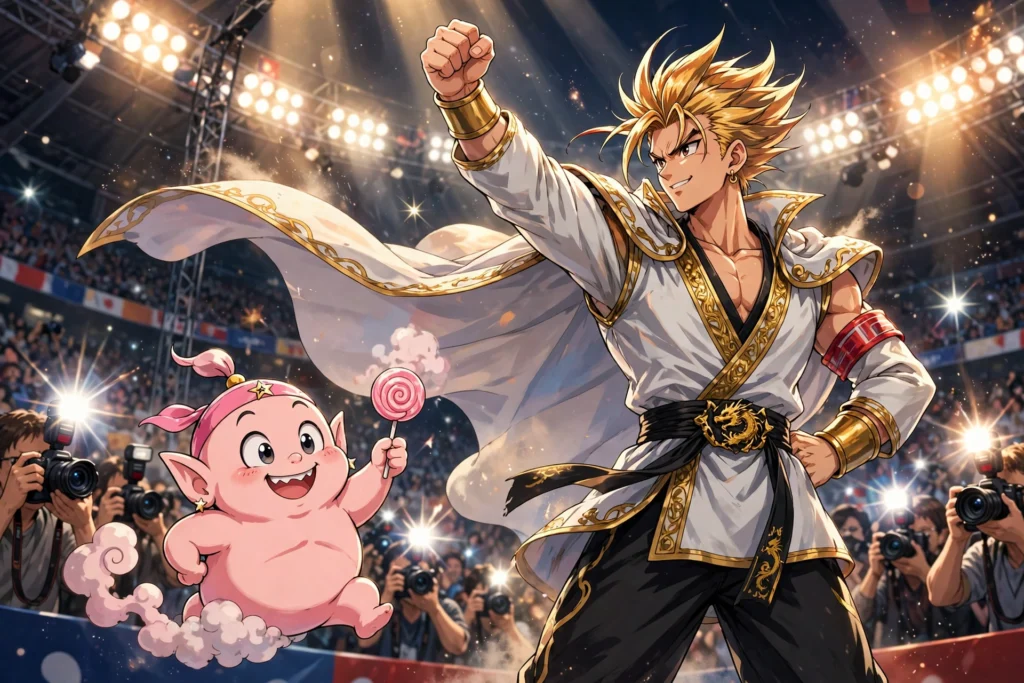
Between the planet-busting, something easy to forget keeps Dragon Ball alive: it is funny, and it was funny first. Here are the funniest dragon ball characters ranked by how much of that humour belongs to the character rather than the scene around them. Dragon Ball began as a comedy manga with martial arts in it. Akira Toriyama arrived from Dr. Slump, a gag series, and he brought that timing with him — the sideways glance, the bathos, the hero who wins the fight and loses the conversation. The fighting grew over the comedy as the years passed. It never replaced it. Peel away the transformations and the power levels and the gag writer is still underneath, setting up the next fall.
That is why a ranking like this is not a break from the serious lists. Comedy is load-bearing in this franchise. It gives the audience somewhere to breathe between catastrophes, it makes an ensemble out of people who would otherwise only meet to fight, and it tells you who these characters are when nobody is trying to kill them. A fighter who is funny only because the plot puts a custard pie in his path has a good scene. A fighter who would be funny in a waiting room, a training field or the end of the world has something rarer, and that difference decides every place below.
How We Ranked Them
One test, applied the same way to everyone: how much of the comedy is character, and how much is situation? Situation comedy needs the right setup — a disguise, a misunderstanding, a tournament rule sprung at the wrong moment. Character comedy travels. Put the person in any scene, with any opponent, at any stakes, and the joke arrives with them because it is built out of who they are: a fraud’s nerve, a child’s ego, a god’s appetite, a realist’s dread.
So we asked, for each fighter, what happens if you strip the scene away. Does the humour survive a change of era, enemy and circumstances? Does it deepen the character instead of pausing him? And has it lasted — is the joke still working decades after it first appeared, or did it belong to one arc and one moment? The eight below passed all three questions. The order is where the argument lives.
8. Beerus — The Straight-Faced Catastrophe
Beerus is funny the way a loaded die is funny: the laugh comes from knowing what is riding on something small. A God of Destruction judges planets, in part, by their food, and in the Battle of Gods story a dispute over a pudding cup — described generally, a dessert promised and then withheld — becomes a diplomatic incident with extinction on the table. Everyone around him understands the danger. Beerus, serenely, does not care, and he is played completely deadpan by everyone including himself, which is the whole mechanism. There is no wink. A catastrophe is simply having a mood.
He ranks last here for a reason this test makes unavoidable: his humour is seasoning, not substance. Beerus needs Whis to manage him, a spread of food to tempt him and a cast of terrified hosts to react to him. Remove the banquet and the dread, and the character reverts to what he mostly is — a genuinely frightening, genuinely detached god who naps through history. That is a great flavour to add to Super, and the deadpan is impeccable. But on a list that rewards comedy a character carries alone, the god who needs catering finishes eighth, and would probably destroy something expensive about it after a nap.
7. Goku — The Accidental Comedian
Goku is not trying to be funny, which is exactly why he is. His comedy is purity of focus: a mind so completely organised around fighting, food and fairness that every social room he enters quietly breaks. He negotiates with gods like neighbours, because to him a god is mostly a strong person he has not sparred with yet. His marriage itself rests on a childhood misunderstanding — as a boy he agreed, without grasping what the word meant, to a promise Chi-Chi held him to years later — and the joke is not that he was tricked. It is that, told what he had promised, he simply honoured it, in the same tone he would use for a training appointment.
Super leans on this at home, in his farming-era cluelessness about money, work and ordinary adult embarrassment, described generally. The humour is real, and it is entirely his. But it ranks seventh because it is a by-product. Goku generates comedy the way a fire generates light — incidentally, while doing something else. The characters above him aim their humour, live inside it, or in Krillin’s case suffer it professionally. Goku would finish this entry mid-sentence if something stronger walked past, and that, of course, is the joke working as intended.
6. Krillin — The Straight Man as Art Form
Every ensemble needs one person who can see the disaster clearly, and Krillin has held that post longer than anyone. He is the franchise’s designated realist, and his comedy is reaction: fear, disbelief and exasperation voiced for the audience, at exactly the moment the audience needs a voice. When a plan is insane, Krillin is the one who has noticed. When a villain is beyond reason, Krillin’s face files the report before anyone speaks. It sounds like a supporting skill. Watch any arc without it and the whole thing floats away — somebody has to stand at human height and measure how absurd the sky has become.
The fandom understood this so well that it built a running gag around him, described generally: the owned-count jokes, tallies kept by fans of his defeats and humiliations as if they were a league table. That gag only works because the series itself keeps appointing him its witness. He ranks sixth, not higher, because reaction is a dependent art — he needs something enormous to react to. But being the funniest reactor in a cast of gods and Saiyans is a real skill, honed over decades, and nobody on this list does his particular job at all.
5. Yajirobe — Comedy by Refusal
Yajirobe is the only character whose superpower is not caring, and in this franchise that is close to a miracle. His pattern never changes and never stops working: he eats, he complains, he delivers the Senzu beans at the moment they are needed, and he leaves before anyone can make a hero of him. Other characters have arcs. Yajirobe has an exit strategy. In a series built on men screaming themselves into new forms, comedy by refusal is rarer than comedy by explosion, and his deadpan is the ballast every ensemble needs — proof that someone present still thinks all of this is, on balance, too much trouble.
His finest hour makes the point perfectly, so let us state it precisely: in the Saiyan saga, his sword cut off Great Ape Vegeta’s tail, undoing the transformation at the moment the surviving heroes had almost nothing left. It is played, structurally, as a joke — the least invested man on the battlefield landing one of its most decisive blows — and it saved the world. That combination is pure Yajirobe, and it is a large part of why that ending lingers in every Dragon Ball saga finale, ranked. Fifth place is his ceiling only because he appears in short doses. Per minute on screen, almost nobody here is funnier.
4. Master Roshi — The Legend Who Outgrew His Own Gag
Roshi was the dirty-old-man engine of the original series, and we should say plainly and fairly that many of those early gags are of their era: the leering, the schemes, the nosebleeds played as punchlines belong to a younger medium and a different audience, and returning viewers are allowed to find them tired. Ranked on that material alone, he would sit near the bottom of this list, and this entry will not pretend otherwise.
What lifts him to fourth is that the character outgrew the gag instead of being retired with it. The comedy in later Dragon Ball runs on the gap between the lecherous legend and the wise master — the same man who founded a school, trained heroes and carries centuries of judgment, still undone by his own appetites. In the anime’s Tournament of Power storyline (anime material, described generally), he prepares for the arena by training against his own temptation, turning the oldest joke about him into a discipline he has to defeat before he can fight anyone else. That is a genuinely better joke: the flaw became the training. The lecherous legend and the wise master share the same pair of sunglasses, and the series is funnier, and kinder, for insisting both are really him.
3. Majin Buu — Innocence at Planet-Ending Power
The fat Majin Buu is comedy by innocence: a planet-ending power with a toddler’s inner life. His wants are immediate and domestic — sweets, play, approval, a nap — and they arrive with the force of a natural disaster, which is the whole dissonance. Villains in Dragon Ball usually announce themselves. Buu wanders in asking, in effect, what is for dessert, and the terror and the absurdity are the same fact. He is funny in any scene because the mismatch is inside him: nothing in his manner scales to his power, and nothing in his power dents his manner.
His funniest material is tellingly his quietest: the house he built for himself, the dog he adopted and healed, and the friendship he forms with Mr. Satan, the one person who approaches him without a weapon. Domestic Buu is the joke and the thesis at once. He is the rare gag character who is also an argument about what power does without malice — Buu suggests that destruction, in him, is not cruelty but a child’s game played at cosmic scale, and that kindness reaches him in a way force never could. Third place, and the highest-ranked character on this list who frightened us before he charmed us.
2. Gotenks — The Purest Joke Engine in Z
Gotenks is two children’s combined ego as a weapons program, and he is magnificent. Where other fusions are solemn instruments of last resort, Gotenks treats a fight for the planet as an opening night. He invents attacks with theatrical names and unveils them like product launches. He holds mid-fight press conferences with himself. His entrance takes longer than some fights. None of this needs a setup, a victim or a straight man: fusion hands him an audience of everyone, and showmanship does the rest. Drop him into any scene and the scene becomes a stage within about four seconds.
His fight with Buu is the comedy of overconfidence played at full length — a warrior who could compete, choosing instead to perform, rationing his own effort for dramatic effect while the clock and the stakes punish him for it. The humour has a real edge, because his vanity nearly costs everything, and Piccolo’s despair on the sidelines is the audience’s. A note on categories: Gotenks is a fusion, a single new person rather than a partnership, which is why he does not belong in Dragon Ball’s greatest team-ups, ranked — he is a solo act with two childhoods. He finishes second here only because the man above him has been running his joke for longer, at higher stakes, with his life genuinely on the line. As a pure joke engine, though, nothing in Z touches Gotenks.
1. Mr. Satan — The Beautiful Fraud With a Real Heart
Mr. Satan is the longest-running gag in the franchise that never gets old, because it is also the most human story on the show. He is a coward and a fraud: a genuinely skilled human martial artist, by human standards, who wandered into an era of gods and solved it the only way available to him — by lying, magnificently, in public, forever. He takes credit for Cell’s defeat, a theft the actual heroes let stand, and then has to live inside the lie for the rest of his life, one televised boast at a time. A coward’s cape worn so long it became a uniform: the costume is the man, now, and he can never take it off.
And then the joke turns, twice, into the plot. In the Buu saga his bluff, his fame and his strange, sincere friendship with Buu himself become load-bearing — and at the climax it is Mr. Satan who genuinely rallies the people of Earth to raise their hands and give their energy to the Spirit Bomb that ends Kid Buu. The fraud’s stolen authority turns out to be the one tool the real heroes lack: the world believes him. That is why he tops this list. His comedy passes the character test completely — he is funny in a press conference, a palace, a battlefield and a quiet room with a monster — and underneath it sits a heart the series honours. Away from the cameras he is also, quietly, one of its decent parents, a thread we followed in Dragon Ball’s best fathers, ranked. The other seven are funny. Mr. Satan is funny and, in the end, necessary.
The full ranking, at a glance:
| Rank | Fighter | Brand of comedy | Funniest era |
|---|---|---|---|
| 1 | Mr. Satan | Beautiful fraud with a real heart | Dragon Ball Z — Cell and Buu sagas |
| 2 | Gotenks | Pure showmanship and invented spectacle | Dragon Ball Z — Buu saga |
| 3 | Majin Buu | Innocence at planet-ending power | Dragon Ball Z — Buu saga |
| 4 | Master Roshi | Lecherous legend meets wise master | Dragon Ball, with a Dragon Ball Super coda (anime) |
| 5 | Yajirobe | Deadpan refusal | Dragon Ball and early Dragon Ball Z |
| 6 | Krillin | Reaction, fear and exasperation | Dragon Ball Z |
| 7 | Goku | Accidental, earnest misunderstanding | Across the series, especially Super at home |
| 8 | Beerus | Straight-faced catastrophe | Dragon Ball Super — Battle of Gods era |
The Joke the Series Cannot Retire
Our verdict is Mr. Satan, and the argument is the ranking itself. Gotenks depends on two particular children and a thirty-minute clock. Buu’s innocence was a discovery that can only be made once. Roshi’s second act is a coda. But the ordinary human standing in front of a crowd, claiming a strength he does not have and somehow making the claim matter, answers a question Dragon Ball will never stop asking: what is a normal person for, in a universe of gods? Every new era raises the power ceiling and strands ordinary humanity further below it, and every era therefore needs its Satan — the witness, the translator, the beloved liar whose connection to the crowd is a power the gods genuinely lack.
That is the joke the series cannot retire, because it is not only a joke. It is the franchise’s promise that the human scale still counts, delivered by its least powerful regular character, in a cape, to camera. Long may he take the credit.
Frequently Asked Questions
Who is the funniest Dragon Ball character?
Mr. Satan, on our character test. His comedy travels to any scene, has run from the Cell Games to the end of Z without wearing out, and twice becomes the mechanism that saves the world — first through stolen credit, then by rallying Earth for the Spirit Bomb.
Why is Gotenks ranked so high?
Because his humour needs nothing but himself. The invented attacks, the theatrical unveilings and the mid-fight press conferences with himself are generated entirely by two children’s combined ego, so the joke works in any scene — the definition of character comedy on this list.
Why is Goku only seventh?
Because Goku is an accidental comedian. His misunderstandings — including the marriage-by-misunderstanding with Chi-Chi and his farming-era cluelessness in Super — are by-products of his focus on fighting, not a comic craft he practises. He is funnier than almost anyone here without trying, and trying is what the top six do.
Why does Master Roshi rank in the middle?
Because his material splits in two. The early dirty-old-man gags are of their era and have aged unevenly, which caps his place. His later comedy — the gap between the lecherous legend and the wise master, including his anime Tournament of Power preparation against temptation — is better, kinder and entirely his, which lifts him to fourth.
Is Majin Buu funny or dangerous?
Both, and the combination is the point. The fat Buu pairs planet-ending power with a toddler’s inner life, and his funniest material is domestic — the house he built, the dog he befriended and his friendship with Mr. Satan. He is a gag character who also works as a thesis about power without malice.
Why is Beerus last if his scenes are so funny?
Because his humour is seasoning rather than substance. The deadpan catastrophe — planets riding on appetite and mood, as in the Battle of Gods pudding incident — needs a banquet, a manager in Whis and a room full of frightened hosts. It is a superb flavour for Super, but it depends on situation more than any other entry here.