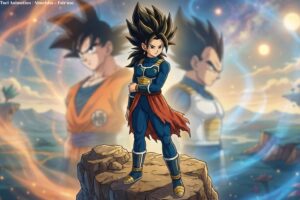
Dragon Ball Kakumei is a popular Dragon Ball fan project that has gained a lot of attention from anime fans around the world. Many people search for Dragon Ball Kakumei because it presents a different version of the Dragon Ball universe with a more serious tone and deeper story themes. Unlike the official series, this project focuses strongly on power balance, divine authority, and rebellion.
This article explains what Dragon Ball Kakumei is, its story concept, characters, and why it has become so popular among fans.
What Is Dragon Ball Kakumei

Dragon Ball Kakumei is a fan-made manga inspired by the Dragon Ball universe. It is not created, written, or approved by the official owners of Dragon Ball. The project was developed by fans who wanted to explore ideas that are rarely shown in the official storyline.
The word Kakumei means “revolution” in Japanese. This name reflects the main theme of the story, which is about change, resistance, and conflict against powerful divine forces. Dragon Ball Kakumei presents a universe where the balance between gods and mortals begins to collapse.
Is Dragon Ball Kakumei Canon

Dragon Ball Kakumei is not canon. This means it is not part of the official Dragon Ball timeline and does not affect the main story told in the manga or anime.
Even though it is not official, many fans still enjoy it because it feels carefully written and respectful to the original universe. It should always be viewed as a fan interpretation rather than an official continuation of Dragon Ball.
Dragon Ball Kakumei Story Overview

The story of Dragon Ball Kakumei focuses on large-scale conflict involving gods, angels, and powerful warriors. Instead of focusing only on personal rivalries, the story explores wider issues such as authority, justice, and the consequences of unlimited power.
In this version of the universe, divine beings face challenges from those who question their rule. The story highlights tension between different sides and forces characters to make difficult decisions. Battles are not just about strength but also about strategy and responsibility.
Characters in Dragon Ball Kakumei

Dragon Ball Kakumei includes many familiar characters from Dragon Ball, but they are placed in new situations that change how they act and think. Characters such as Goku, Vegeta, and Gohan are shown dealing with conflicts that go beyond simple battles.
Gods of Destruction and angel-level beings also play an important role in the story. These characters are portrayed with more seriousness and mystery, making the story feel heavier and more dramatic than the official series.
Power System in Dragon Ball Kakumei

Power in Dragon Ball Kakumei is handled differently compared to the official Dragon Ball story. Instead of introducing many new transformations, the project focuses more on how power is used and controlled.
Fighting relies heavily on teamwork, tactics, and understanding divine rules. Strong characters still exist, but raw strength alone is not always enough to win. This approach makes battles feel more unpredictable and thoughtful.
Why Dragon Ball Kakumei Became Popular

Dragon Ball Kakumei became popular because it offers something different from the official series. Many fans appreciate its serious tone and the way it treats god-level characters with more depth.
The artwork is also considered high quality for a fan project, which helped it gain attention online. The combination of strong visuals and a mature storyline made many fans curious to read more.
Where to Read Dragon Ball Kakumei

Dragon Ball Kakumei is usually shared online for free by its creators. Since it is a fan-made project, it is not sold commercially and is distributed as a passion project.
Readers should always respect both the fan creators and the official Dragon Ball rights holders when accessing the content.
Is Dragon Ball Kakumei Getting an Anime

There is currently no official anime adaptation of Dragon Ball Kakumei. Because it is not a canon project, it cannot receive an official anime series.
Any videos or posts claiming an anime adaptation are usually fan-made concepts or unofficial animations.
Dragon Ball Kakumei vs Official Dragon Ball

Dragon Ball Kakumei and the official Dragon Ball series exist separately. The fan project focuses more on serious storytelling and divine conflict, while the official series follows an approved canon timeline with a broader audience in mind.
Both versions can be enjoyed, but they should not be confused with each other.
Final Thoughts
Dragon Ball Kakumei is a strong example of how creative and passionate the Dragon Ball fan community is. While it is not an official part of the Dragon Ball universe, it offers an interesting alternative perspective with deeper themes and thoughtful storytelling.
Fans who enjoy mature ideas and god-level conflicts may find Dragon Ball Kakumei worth reading, as long as it is understood as a fan-made project.
A Fan Manga Taken Seriously
Most fan manga are read once, shared briefly, and forgotten, but Kakumei is routinely discussed in the same conversations as official releases, and the first reason is how seriously it takes its own presentation. Its artwork is polished to a degree that is rare in fan work, aiming squarely at the look of the modern official manga and mimicking Toyotarou’s style closely: clean line work, familiar character models, and pages that could sit beside official chapters without the art giving the game away. When readers cannot tell at a glance that a page is unofficial, the project earns a level of attention that most fan works never approach.
The second reason is staying power. Kakumei is not a one-shot, a short tribute, or a handful of chapters released and abandoned. It has run as a long-running serialization by fan standards, shared online for free as an ongoing project, and that continuity changes how it is read. Readers follow it the way they follow an official series: waiting for the next installment, tracking a developing story, and arguing about where it is heading. A fan project that survives long enough to build those habits stops being a curiosity and starts being treated as a work in its own right.
The third reason is scale. The premise is not a single grudge match or a rematch fans asked for. It is a conflict at the level of the whole divine order: gods, angels, destroyers, and mortals pulled into a struggle in which, as this article describes, the balance between gods and mortals begins to collapse, and divine beings face organized challenge from those who question their rule. A revolution aimed at heaven itself is a much larger canvas than fan projects usually attempt, and it is the main reason Kakumei gets talked about as ambitious rather than just well drawn.
The Legal and Canon Reality
None of that praise changes what Kakumei legally and canonically is, and it is worth stating as plainly as possible. Dragon Ball Kakumei is unofficial fan work. As the article above notes, it is not created, written, or approved by the official owners of Dragon Ball. It is not canon, it is not licensed storytelling, and it carries no authority over the franchise. Its characters, outcomes, and power displays exist only inside its own pages, however polished those pages look.
Reading it changes nothing about official continuity. No event in Kakumei obliges the official manga or anime to acknowledge it, no character’s official status is altered by anything the fan story does, and if an official release one day contradicts it, the official version simply is the continuity and Kakumei remains what it always was: a fan interpretation. Keeping that line clear is not a criticism of the project. It is what allows fans to enjoy both versions, as this article puts it, without confusing one for the other.
There is also a practical consequence of being unlicensed. Fan works like this survive on the tolerance of the rights holders: they exist because the people who own Dragon Ball allow them to circulate, not because the fan creators hold any right to publish them. Tolerance can be withdrawn, platforms can change their rules, and projects can be paused, moved, or removed. That is why the availability of a fan manga can change at any time, and why readers should enjoy it while it is accessible and support its creators respectfully, without assuming it will always be one search away.
What Official Dragon Ball Could Learn From It
Kakumei’s following is, among other things, market research the official series never had to pay for. It proves there is a large, patient audience for territory official Dragon Ball introduced and then left largely in the background. The other universes are the clearest example: an entire multiverse of fighters, gods, and cultures was put on the table, and most of it still sits unexplored. The angels’ hierarchy is another: beings of obvious rank, rules, and mystery stand at the center of the divine order, yet their internal order, duties, and tensions remain barely touched by official stories.
The second hunger Kakumei feeds is for long-form consequences. Official arcs tend to resolve and reset: the universe is threatened, the universe is saved, and the status quo quietly returns. Kakumei’s whole premise runs the other way, with authority questioned and staying questioned, and decisions accumulating instead of evaporating. Fans responding to that are not asking for a darker series for its own sake. They are asking for events that echo, where what happened ten chapters ago still shapes what characters can do now.
None of this means official Dragon Ball should adopt a fan story, and it could not do so in any case. The lesson is about appetite rather than material. When official stories circle the same gaps Kakumei explores — the wider universes, the ranks of the angels, consequences that carry — they are moving toward ground a fan project has already shown to be fertile. Kakumei’s success is best read as a signal flare from the audience: this is the territory we are waiting for someone to properly explore.
| Dragon Ball Kakumei | Official Dragon Ball | |
|---|---|---|
| Creator status | Made by fan creators as a passion project; not created, written, or approved by Dragon Ball’s official owners | Created by Akira Toriyama, continued by Toyotarou, and produced by Toei Animation and the official rights holders |
| Canon status | Not canon — a fan interpretation that does not affect the official story | The official canon timeline that the manga and anime follow |
| Where the story sits | Its own separate version of the universe, built around large-scale conflict between gods, angels, and mortals | The approved Dragon Ball timeline shared by all official stories |
| Art style aim | Polished, high-quality art for a fan project, aiming to match the official manga look and mimic Toyotarou’s style | The original manga art style established by Toriyama and continued by Toyotarou |