
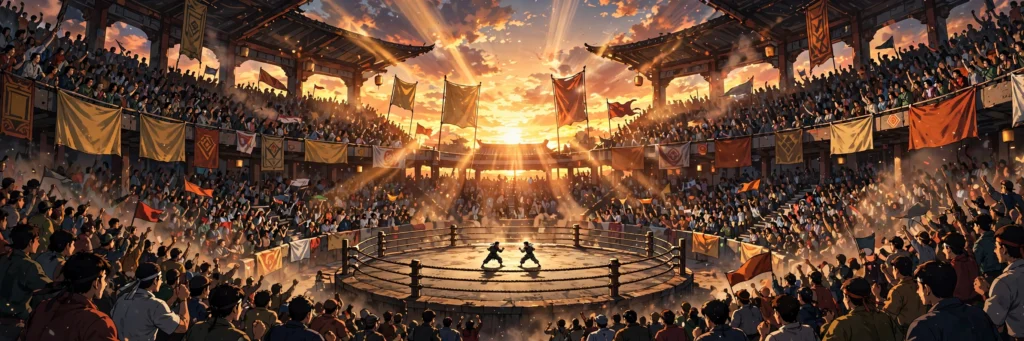
Strip Dragon Ball down to its frame and you find a bracket. A boy walks into a tournament to test himself against strangers, and the series discovers, in public, under rules, with a crowd counting along, who he is becoming. Then it does it again, bigger. And again. Tournaments are where Dragon Ball tells the truth about itself in public: new rivals become friends there, old teachers hide inside the draw, villains learn to wait politely for their turn, and eventually entire universes get seated in the same arena. That is why any attempt to get dragon ball tournaments ranked in an order everyone accepts is doomed from the start. Every fan carries a different final in their chest.
So here is ours anyway. Eight major tournaments, counted down from eighth to first. Some are pure sport. One is a villain borrowing sport as stage dressing. One never even got to finish. One is not canon at all, and we are ranking it anyway, honestly labelled. What they all share is the heartbeat: a ring, a set of rules everyone pretends will hold, and a last fight that tells you what the whole era was really about. Dragon Ball is a tournament series first and a save-the-world series second, and this list is our argument for why.
How We Ranked Them
We scored every tournament on four things. Drama: did the bracket produce stories, grudges and turns, or only results? Stakes: what did losing actually cost — pride, a life, a planet, or everything that exists? Fight quality: not just power, but choreography, variety and readability, which is why the early tournaments win points that raw scale cannot buy back. And how the final landed, because a tournament is only ever as good as the fight people still describe first when its name comes up.
Canon weighs in too, and we state that honestly rather than hiding it. A non-canon tournament starts with a handicap on this list, because a final the main story can never build on simply matters less in the long run, however beloved it is. Where two tournaments finished close, we asked a simpler question: which one would we hand to a new fan and say, watch this, this is what Dragon Ball is? That question settled every tie below.
8. Other World Tournament — Dragon Ball Z (Filler)
First, the honest label, in capital letters if it helps: this is FILLER. The Other World Tournament is anime-only, non-canon, staged in the afterlife while Dragon Ball Z paused after the Cell Games. Goku, newly dead and somehow still training, competes against the greatest fighters of the four galaxies under the Grand Kai, with weight classes, brackets and bragging rights that span whole quadrants of the afterlife. His final against Pikkon — quiet, proud, and strong enough to have handled Cell — remains a genuine fan favourite, and Pikkon himself is one of the most popular characters never to enter canon.
And it is last. Let us be completely clear about why, because there is exactly one reason: it is non-canon. That is the sole reason it sits at number eight. On entertainment alone it would climb, because it proved something valuable — that the tournament format works absolutely anywhere, even among the dead, even with nothing at stake but pride. The fights are fun, the setting is inventive and the final lands well. But nothing here can echo forward. No later arc can build on it, no character can grow from it, and a ranking that claims canon matters has to charge it for that. Beloved filler is still filler.
7. 25th Tenkaichi Budokai — Dragon Ball Z
The Buu-era tournament is the great what-if of this list. Its early pieces are wonderful. The kids’ division gives us Goten against Trunks, two children fighting at a level their fathers reached as adults, played mostly for joy — and the crowd, and the reader, loving it. The adult draw looks loaded too: Gohan, Vegeta, Piccolo and Android 18 in the same bracket, with Mr Satan performing his usual miracle of surviving his own legend. For a few chapters, Dragon Ball remembers how to be a sports story again.
Then reality checks arrive. Videl, a skilled but entirely human martial artist, is fed to Spopovich, a man juiced up by dark magic who cannot feel pain — and her beating is one of the most uncomfortable sequences the series ever produced, precisely because the tournament’s rules offer her no protection at all. Soon after, the Majin crisis swallows the event whole. Fighters abandon the ring, the bracket collapses, and the tournament never gets its final. We rank it seventh for its pieces — the kids’ final, Videl’s bravery, the nostalgia of the format itself — while noting plainly that it never got to be itself. A tournament that cannot finish cannot finish high.
6. Universe 6 vs Universe 7 Tournament — Dragon Ball Super
Super’s first tournament reinvents the form by shrinking it. Two teams of five, a wager between twin Destroyers, and stakes that are — by Dragon Ball standards — almost friendly: a planet swapped between universes and a wish on the Super Dragon Balls. That smaller scale is the point. With extinction off the table, the fights can breathe, and the bracket becomes an introduction tour: Frost’s cheating, Vegeta mentoring Cabba mid-fight, and above all Hit, the assassin from Universe 6 whose Time-Skip makes opponents look like they are fighting a man who edits the match as he goes.
The final, Goku against Hit, delivers Super’s first great gamble: Super Saiyan Blue stacked with the Kaioken, a technique combination Goku himself admits could cripple or kill him, thrown against an opponent who improves every time he is pushed. And hovering over the whole small tournament is its huge consequence. Zeno shows up to watch. The Omni-King’s casual interest in this little contest is the first hint of a much larger game, and it leads directly to the Tournament of Power. Small scale, enormous aftershock — but the middle of the bracket is thin and the Monaka joke takes up space a real contender should have filled, so sixth is where it lands.
5. Cell Games — Dragon Ball Z
Now the honest label this entry needs. The Cell Games borrow the tournament form — a ring, announced rules, challengers stepping up one at a time — and use it as a villain’s theatre. Cell builds an arena, issues an invitation and waits, not because he respects sport but because he wants an audience for his own perfection. It is a tournament the way a hostage video is a press conference: the furniture is right and the purpose is entirely wrong. There is no draw, no bracket, no fair field. When the rules stop suiting Cell, he simply changes them, up to threatening the planet itself. We argue its placement on exactly that basis.
Because judged purely as a final, it would top this list. Gohan’s Super Saiyan 2 transformation, triggered by loss and a lifetime of swallowed anger, is an all-time Dragon Ball moment; Goku’s sacrifice and the father-son finish that follows are close behind. That is the hidden fear every Dragon Ball character carries made visible — even Cell, for all his showmanship, is performing confidence over the terror of being surpassed. So why only fifth? Because everything before Gohan is mostly a queue. Great theatre, one immortal final, and a tournament in name only: fifth is the honest compromise between those three truths.
4. 21st Tenkaichi Budokai — Dragon Ball
The first one, and still the purest. The 21st Tenkaichi Budokai looks like a simple test for two trained boys, until you notice what Master Roshi is doing: disguised as the mysterious Jackie Chun, he enters his own students’ tournament to make sure they lose. Not out of cruelty — out of love. His whole secret lesson is that the world is wide, that there is always someone stronger, and that winning too young would end Goku and Krillin’s growth before it started. The final is a master teaching his student the most important thing a teacher can teach, at full power, in disguise.
It is also gloriously strange. Goku’s tail turns the final into a monster fight under a full moon, and Roshi’s answer is to destroy the moon itself — the moon died so a lesson could land. Every later tournament copies this one’s template: the training, the comic early rounds, the rival who becomes a friend, the final that is really about who the hero is becoming. We traced that teaching line in our ranking of Goku’s teachers, and it starts here. Why not higher? The choreography is still young and the early rounds lean on gags. But as a blueprint, nothing on this list matters more.
3. 22nd Tenkaichi Budokai — Dragon Ball
If the 21st is the template, the 22nd is where the template grows teeth. This is the Crane School tournament: Master Shen brings Tien and Chiaotzu to humiliate Roshi’s Turtle School, and the bracket becomes a genuine school war, fought with grudges, dirty tricks and real technique. Its best story happens between the fights. Tien arrives as a villain — arrogant, cruel, proud of it — and begins, mid-tournament, to turn. Roshi talks to him like a person instead of an enemy, Tien’s own conscience does the rest, and by the final he is fighting to prove he can be something better than what his master made him.
This is also the tournament where the series’ fight choreography grew up: flight as a standard tool, the Kikoho as a life-burning gamble, matches won by reading an opponent rather than out-muscling him. And then there is the final. Goku and Tien, both spent, both falling from the sky, the first to touch the ground loses — and Goku, on his way down, bounces off a passing truck. He hits the street a heartbeat before Tien, and the greatest final of its era is decided by traffic and luck. We say that fondly, not as a complaint: after all that skill and growth, Dragon Ball lets chance flip the last coin, and it feels honest. Third place, earned.
2. 23rd Tenkaichi Budokai — Dragon Ball
The classic era saved its best for last. Three years after losing to Tien, Goku returns to the 23rd Tenkaichi Budokai as an adult, and waiting in the draw is Piccolo Jr. — the reincarnation of King Piccolo, raised for one purpose: to kill Goku in front of the whole world. Their final is the most violent and personal of the classic era. There is no sportsmanship left in it. Piccolo breaks Goku down piece by piece, limb by limb, buries him, believes he has won — and Goku still gets up. It is, in the best Dragon Ball way, a bracket with a body count and a wedding at the end, because minutes after finally winning his first tournament, exhausted and barely standing, Goku agrees to marry Chi-Chi, honouring a childhood promise he never understood.
Everything about this tournament is a hinge. Goku’s first tournament win, after two lost finals, pays off the entire original series. Piccolo, spared at the end, becomes the seed of the alliance that defines Z. Adult Goku, married Goku, a world about to meet Raditz — the perfect bridge into Dragon Ball Z is built right here, inside a final. Why is it not first? Only because of what sits above it. If your own list puts the 23rd at number one, on drama and on how its final landed, we will not argue with you for long. It is that close.
1. Tournament of Power — Dragon Ball Super
The Tournament of Power takes the format Dragon Ball invented and detonates it. Eighty fighters. Eight universes. One arena in a void, no flight tricks to save you, ring-outs instead of knockouts — and existence itself at stake, with every losing universe erased. It is a battle-royale reinvention of everything the Tenkaichi Budokai ever stood for, and for most of its run it forces something the series rarely attempts: teamwork. Fighters win by saving each other, by trading themselves for position, by thinking in units instead of duels. Android 17, written off for years, becomes its most valuable player. That reinvention alone earns it the top two.
Then the final lands, and it stops being close. This tournament was Ultra Instinct’s debut stage, and Goku’s last stand against Jiren — a man so strong he seems less like a fighter than a verdict — builds through exhaustion, trust and one impossible alliance, with Goku and Frieza, of all people, throwing Jiren out together while Android 17 stays standing. It is also a live demonstration of why Dragon Ball’s villains have learned to fear Saiyans: they keep improving in the middle of the fight that was supposed to finish them. Now the honest cost, because we promised it: some of the eight universes are sketches rather than teams, a few fighters exist only to be eliminated, and the middle stretch of the tournament sags before the great final run rescues it. We are saying so plainly — and ranking it first anyway. Drama, stakes, fight quality and a final that landed like a thunderclap: on our own criteria, nothing else takes all four at once.
The Ranking at a Glance
| Rank | Tournament | Series | The final | Why it sits here |
|---|---|---|---|---|
| 1 | Tournament of Power | Dragon Ball Super | Goku, Frieza and Android 17 vs Jiren | Scale, stakes and a final that landed — despite a sagging middle |
| 2 | 23rd Tenkaichi Budokai | Dragon Ball | Goku vs Piccolo Jr. | The most personal classic final; a first win, a proposal and the bridge into Z |
| 3 | 22nd Tenkaichi Budokai | Dragon Ball | Goku vs Tien | Tien’s turn, grown-up choreography and a final settled by luck |
| 4 | 21st Tenkaichi Budokai | Dragon Ball | Goku vs Jackie Chun | The template for everything after: a lesson disguised as a tournament |
| 5 | Cell Games | Dragon Ball Z | Gohan vs Cell | An all-time final inside a tournament in name only |
| 6 | Universe 6 vs Universe 7 Tournament | Dragon Ball Super | Goku vs Hit | Small scale, huge consequences — it set up the Tournament of Power |
| 7 | 25th Tenkaichi Budokai | Dragon Ball Z | Never played — interrupted by the Majin crisis | Great pieces, but the tournament never got to be itself |
| 8 | Other World Tournament | Dragon Ball Z (filler) | Goku vs Pikkon | Beloved filler; last only because it is non-canon |
The Tournament the Series Still Owes Us
Here is the discussion we actually want to have. Dragon Ball has staged tournaments for practice, for planets and for existence itself — but it has never staged a genuine, modern Tenkaichi Budokai with the current cast at full power. On Earth. In a ring. With a crowd, a bracket, ring-outs and no universe being erased if the wrong man loses. Just the strongest people alive agreeing, for once, to find out. The series owes us that tournament, because every era before Super got one, and this era — the strongest cast the franchise has ever had — somehow never has.
Picture the draw. Gohan, finally fighting at his ceiling instead of apologising for it. Broly, whose real test would not be power but control — can the strongest man in the bracket win inside rules that punish losing control? Orange Piccolo. Vegeta and Goku, still arguing about seeding like it is a matter of honour. And then Pan’s generation knocking on the door: Pan herself, a grown Goten and Trunks, Uub with all that inherited power and something to prove. Who do you seed first? Does Broly even fit in a ring anymore? Does Gohan finally beat his father in a fair fight, in public, with their whole family watching? That is the conversation — tell us your bracket in the comments.
Frequently Asked Questions
What is the best Dragon Ball tournament of all time?
On our criteria — drama, stakes, fight quality and how the final landed — it is the Tournament of Power, with the 23rd Tenkaichi Budokai a very close second. Fans who value a single perfect final over scale and spectacle often put the 23rd first, and that is a defensible list too.
Is the Cell Games really a tournament?
Only in form. It has a ring, announced rules and challengers who step up one at a time, but no draw, no bracket and a host who changes the rules whenever they stop suiting him. We include it because Dragon Ball presents it as a tournament, and rank it fifth because its final is all-time even though its format is a villain’s theatre.
Is the Other World Tournament canon?
No. The Other World Tournament is anime filler from Dragon Ball Z and does not appear in the original manga story. It is beloved, its final between Goku and Pikkon is excellent, and it still finishes last on our list for that one reason alone: it is non-canon, so nothing in the main story can build on it.
Why is the Tournament of Power ranked above the 23rd Tenkaichi Budokai?
Scale and reinvention. The 23rd has the more personal final, but the Tournament of Power reinvented the format as an 80-fighter battle royale, put existence itself at stake, made teamwork matter, and still landed its final — Goku, Frieza and Android 17 against Jiren — at the highest level. Its weaker middle stretch is why the gap is small, not large.
Which tournament did Goku win first?
The 23rd Tenkaichi Budokai, where he defeated Piccolo Jr. in the final. Goku had reached the final of both previous tournaments and lost each time — narrowly to Jackie Chun at the 21st, and by pure luck, a bounce off a passing vehicle on his way down, to Tien at the 22nd.
Will Dragon Ball ever hold another Tenkaichi Budokai?
Nothing has been confirmed, and we are not going to pretend otherwise. But the format is the series’ heartbeat, the current cast is the strongest it has ever been, and a modern Budokai with Gohan, Broly and Pan’s generation would answer questions fans have argued about for years. Until it happens, it remains the tournament the series still owes us.


Pingback: Dragon Ball's Most Underrated Fights, Ranked
Pingback: Strongest Mortal in Each Universe, Ranked