
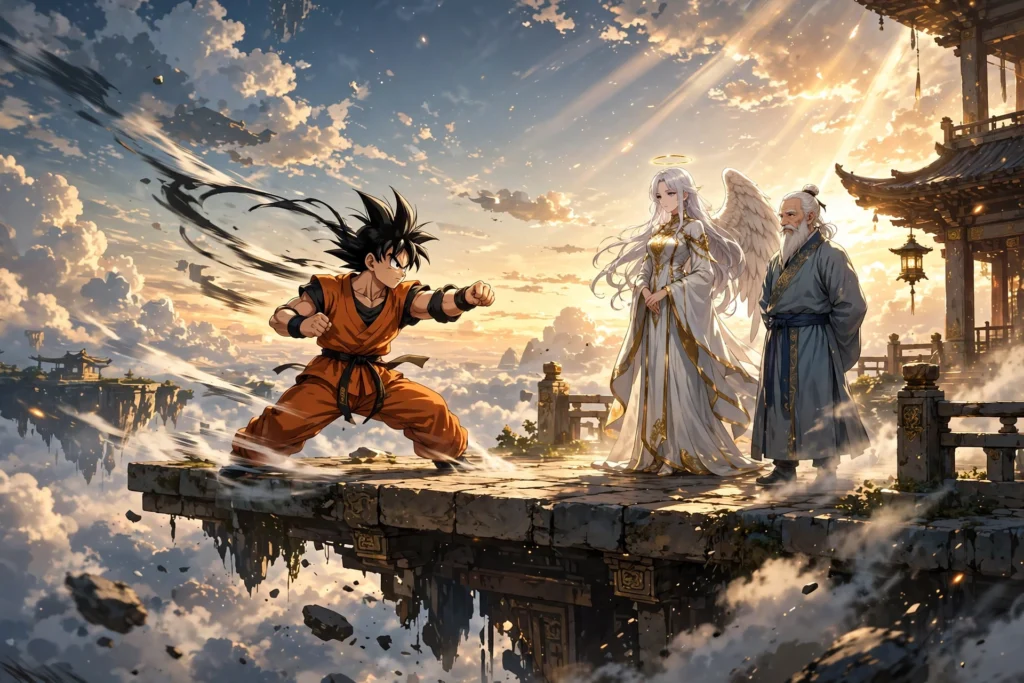
Goku is a student before he is a god. That is the simplest way to understand him, and this Goku teachers ranked breakdown starts there. Strip away the transformations, the tournaments and the screaming power-ups, and what remains is a boy, then a man, who kept finding someone who knew something he did not — and who stayed humble enough to learn it. Every era of his power is a classroom with a different bell, and the ringing never really stopped.
Look at his fighting today and you can still see the handwriting of those classrooms on the wall. The calm breathing comes from one teacher. The signature beam comes from another. The willingness to charge energy for strangers comes from a third. Even the newest, strangest part of his game — a body that answers danger before his thoughts can — was assigned as homework years before he could perform it. His forms tell one story, which we traced in our ranking of every Goku form in Dragon Ball, but his teachers tell the deeper one.
So this is not a ranking of who was strongest, or who Goku loved most, or who spent the longest time with him. It is a ranking of fingerprints. Whose lessons are still visible, under pressure, in the biggest fights of Dragon Ball Super? Count down with us from the first hands that shaped him to the one voice still shaping him now.
How We Ranked Them
Our test was deliberately narrow: lasting impact. A teacher scores highly here only if the lesson still appears in Goku’s fights today — not in a flashback, not as trivia, but as something he actually does when an opponent is trying to end him. A technique he still fires counts. A habit of movement he still relies on counts even more. A way of thinking that decides how he approaches a fight counts most of all.
That test produces some uncomfortable results. A beloved teacher with a short time on screen can finish last, because sentiment is not the metric. A figure who never ran a single formal lesson can finish surprisingly high, because influence is not the same as instruction. And at the very top, two teachers separate themselves from the field for opposite reasons: one built the foundation everything stands on, and the other is rebuilding Goku, right now, into something no mortal syllabus has ever produced.
8. Grandpa Gohan — The First Teacher
Grandpa Gohan ranks last by technique, and we will argue in a moment that he might rank first by everything else. The adopted grandfather who found a strange baby in the mountains gave young Goku his earliest martial arts foundation: basic stances, basic discipline, and the simple expectation that strength should be paired with kindness. There was no advanced curriculum here, no secret technique, and tragically little time — Goku lost him as a small child, in an accident Goku himself unknowingly caused on a full-moon night.
Measured by our test, almost nothing technical survives. Modern Goku does not fight with Grandpa Gohan’s specific moves. Yet the deepest root of the whole tree is his. The openness that lets Goku walk up to every later teacher without pride or suspicion was planted in that mountain home. So was the heart that makes him protect people he has just met. Goku named his first son Gohan, which tells you exactly where this man sits in his private ranking. By lasting technique, eighth is honest. By lasting character, nobody on this list outranks him — and Goku, characteristically, would probably rank the heart higher than we have.
7. Korin — The Patience Teacher
Korin taught Goku with a joke that turned out to be a masterclass. At the top of his tower in the Sacred Land, the ancient cat set the boy a task: take the sacred water from him. For three days, Goku chased, lunged, planned and failed, because Korin was reading every move before he made it. When Goku finally succeeded, the punchline landed — the water was ordinary. The climb up the tower and the pursuit itself had been the training all along.
It sounds slight, and that is exactly why it worked on a student like Goku. A cat who taught by refusing to be caught gave him speed he did not know he was building, breath control earned through frustration, and a first real lesson in humility: someone smaller, older and calmer could be three steps ahead of his strength. Does Korin show up in modern fights? Not as a technique. But every time Goku patiently reads a faster opponent instead of panicking, the tower is in the room. He places seventh because later teachers built directly on this groundwork and left clearer marks — yet without those three days, the groundwork would not exist.
6. Beerus — The Unwilling Teacher
We include Beerus with an honest warning label: he was never Goku’s formal trainer. Training under Beerus’s roof belongs to Whis, and the Destroyer’s own path of instruction — the road toward destruction energy — is the one Vegeta walks, not Goku. Beerus earns his place here as a teacher by example and by rivalry, the most unwilling kind of mentor imaginable: a god who taught Goku chiefly by existing in front of him.
Before Beerus, Goku’s ceiling was always the next villain. After Beerus, the ceiling stopped being a person and became a habit of mind — there is always a level above, held by someone who is not even trying very hard. That changed how Goku trains, how patiently he measures himself, and how hungrily he returns for rematches he keeps losing. There is also one direct borrowing worth flagging. Manga readers only: in the manga, Goku once attempts Hakai, the Destroyers’ erasure technique, against a fused opponent. It is incomplete and borrowed destruction logic rather than a mastered skill (label: MANGA), but it proves the point — even Beerus’s nature, not just his power, has been a lesson Goku studies. Sixth place reflects real influence, honestly framed: a benchmark, not a sensei.
5. Merus — The Finishing School (Manga)
Manga only: everything in this entry comes from the Dragon Ball Super manga, specifically the Galactic Patrol Prisoner Saga, and has not been the centre of an anime arc. Merus presented himself as an elite Galactic Patrolman who had somehow learned to move like something far greater. The reveal reframed every lesson: he was an angel in mortal disguise, training Goku in secret, in a chamber where time allowed them months of work.
His curriculum was narrow and priceless — stabilise Ultra Instinct. Where Whis had planted the principle, Merus turned it into repetitions, corrections and calm, helping Goku reach the state more deliberately instead of only falling into it under desperation. Then the mentorship became the most emotional in Super. Merus cared too much. By intervening directly against Moro, he broke angel law, and the price was erasure from existence — a teacher who quite literally paid with his being for choosing his student over his rules. Goku’s grief and resolve in the fights that followed carry Merus forward even now. He ranks fifth only because his time was cut short; pound for pound, lesson for lesson, few teachers have ever given more.
4. Kami — The Mind Teacher
Kami, working through the ever-patient Mr. Popo on the Lookout, gave Goku the least flashy and most transformative schooling of his youth. The wild boy who had solved problems by charging at them arrived above the clouds and was taught a different order of business: sense ki rather than merely see an opponent, think calmly in the middle of danger, and strip away wasted movement until what remained was only what the fight required.
This is the training that turned raw talent into a martial artist who could read a fight. Watch adult Goku feel out an unfamiliar enemy in the opening exchanges, testing range and rhythm before committing, and you are watching the Lookout years at work. Ki sensing, now so universal in Dragon Ball that fans barely notice it, became the grammar of every later battle — and Kami’s lessons are a major reason Goku speaks it fluently. He finishes fourth because the three teachers above him left techniques and principles that sit even closer to the surface of Super-era Goku, but make no mistake: Kami rebuilt the mind that all of those later lessons were filed into.
3. King Kai — The Power Teacher
King Kai’s lessons were techniques, and what techniques they were. On a tiny planet at the end of Snake Way, under gravity ten times Earth’s, Goku learned the Kaioken — a multiplier that trades strain on the body for explosive power — and the Spirit Bomb, which asks the world itself to lend energy for a single, enormous answer. Between them, those two gifts carried the biggest fights of Dragon Ball Z, from the Saiyan and Frieza sagas onward.
The gravity training mattered too, because it reset Goku’s sense of what hard work felt like; effort that would have broken his earlier self became his warm-up. Crucially for our ranking, neither signature technique retired with Z. The Kaioken returned in Super, stacked daringly on top of a god form, and the Spirit Bomb remains his last-resort argument when his own reserves are not enough. A teacher whose two main lessons are still in the bag decades later, in the era of gods and angels, has earned third place outright. King Kai taught Goku how to multiply power and how to borrow it — and Goku still does both.
2. Master Roshi — The Foundation
Everything stands on Roshi. The Turtle Hermit took in a feral mountain boy and gave him a school, a creed and a technique that would outlive them both. Start with the technique: the Kamehameha took Roshi fifty years to develop. Goku watched him perform it once — once — and copied it on the spot, small and imperfect but unmistakably the same wave. That single scene is the whole Goku story in miniature, and the beam itself never left. Forty years of story later, through gods, angels and universes, the Kamehameha is still the attack Goku reaches for when a fight must be finished. No other teacher’s signature is used so often, by so many generations of viewers, as the sound of a childhood Saturday.
The creed matters just as much. In paraphrase, the Turtle School way balances hard work with honest study and proper rest — train the body, feed the mind, and recover like it is part of the job, because it is. Goku’s entire rhythm of life still follows that pattern: farm work and family meals between universe-threatening training blocks are not filler, they are Roshi’s timetable. Then there is the deepest lesson, delivered simply by Roshi’s example and his warnings: there is always someone stronger out there. That sentence, absorbed young, is why Goku never curdles into arrogance at any power level. He still wears this man’s colours — the orange gi is Turtle School orange — and he still introduces himself, in effect, as Roshi’s student whenever the wave leaves his hands. Whis takes first place only because he is actively rewriting Goku’s future. Roshi wrote the past that made that future possible, and his fingerprint is on every single page of the present.
1. Whis — The Teacher of Godhood
Whis is number one because he is not a chapter in Goku’s education — he is the current syllabus, and everything Goku is becoming traces back through it. When Goku began training on Beerus’s planet, the curriculum changed species: god ki, handled with discipline instead of volume; sparring under amplified gravity and weighted conditions; and corrections delivered so calmly that the student barely noticed he had been dismantled until he was already on the ground. We explored the mystery of his own ceiling in our look at Whis’s real limits and true power, and that bottomlessness is the point — for the first time, Goku’s teacher is not someone he is destined to surpass next arc.
The core of the syllabus can be paraphrased simply: let the body think for itself. Whis taught that reacting with the mind is too slow at the highest level, and that each part of the body should be trusted to respond on its own — the principle that later flowered, under tournament pressure, into Ultra Instinct. Notice what that means for our ranking test. Ultra Instinct is not a technique Goku found; it is Whis’s homework, finally handed in. Every Super-era habit points the same way: the calmer ki control behind his god forms, the patience in his stance, the refusal to waste motion that Kami began and Whis has refined into philosophy. Add the setting itself — regular training on a Destroyer’s world, at gravity and intensity no Earth school could offer — and the conclusion is unavoidable. Roshi’s lessons explain who Goku is. Whis’s lessons explain who Goku is becoming, and because becoming is still happening, in current fights, his impact is the largest of all.
| Rank | Teacher | Signature lesson | Still used today? |
|---|---|---|---|
| 1 | Whis | God ki discipline and letting the body react on its own | Yes — it is the basis of Ultra Instinct |
| 2 | Master Roshi | The Kamehameha and the Turtle School balance of work, study and rest | Yes — his signature technique and colours, every era |
| 3 | King Kai | Kaioken and the Spirit Bomb | Yes — both returned in Dragon Ball Super |
| 4 | Kami (with Mr. Popo) | Ki sensing, calm thought and removing wasted movement | Yes — how Goku reads every fight |
| 5 | Merus (Manga) | Stabilising Ultra Instinct | Yes — in the manga’s later fights |
| 6 | Beerus | A living ceiling to chase; destruction logic by example | Yes — as the benchmark he measures himself against |
| 7 | Korin | Patience, speed and breath control from the tower pursuit | Partly — as habits, not techniques |
| 8 | Grandpa Gohan | First martial arts foundation and a kind heart | Partly — in character more than technique |
The Teacher Goku Still Needs
Here is our verdict, offered as analysis rather than prophecy: nobody left alive in Universe 7 can teach Goku the last step. Whis can explain the principle of Ultra Instinct and refine its edges, as we argued when asking why Ultra Instinct is not Goku’s final form, but a completed, personal version of it — one shaped around Goku’s own nature rather than an angel’s detachment — cannot be handed over like the Kaioken was. It has to be self-taught.
That is not a flaw in the story. It is the point of the whole journey. Every teacher on this list gave Goku something he could not have invented alone, and every gift pointed him a little further inward: from his grandfather’s heart, through Roshi’s discipline and Kami’s calm, to Whis’s quiet body. The final classroom, fittingly, has one student in it. Goku began as a boy who copied a master’s wave after seeing it once. He may finish as the master whose greatest technique is the one nobody taught him.
Frequently Asked Questions
Who was Goku’s first teacher?
Grandpa Gohan, his adoptive grandfather, gave him his earliest martial arts foundation and, more importantly, his kind-hearted outlook. He ranks last here only because our test measures lasting technique, not lasting character.
Why is Whis ranked above Master Roshi?
Roshi built the foundation and his Kamehameha is still Goku’s signature. Whis edges him out because his lessons — god ki discipline and letting the body react on its own — are actively shaping Goku’s current fighting and his Ultra Instinct development right now.
Did Beerus ever actually train Goku?
Not formally. Goku’s trainer on Beerus’s planet is Whis, and the Destroyer-focused path is Vegeta’s. Beerus is included as a teacher by example and rivalry: his existence set the ceiling Goku still chases.
Who taught Goku the Kaioken and the Spirit Bomb?
King Kai, during Goku’s training on his planet under ten-times gravity after Snake Way. Both techniques carried major Dragon Ball Z fights and both have returned in Dragon Ball Super.
Is Merus from the anime or the manga?
Merus’s mentorship is manga material, from the Galactic Patrol Prisoner Saga of the Dragon Ball Super manga. He was an angel in mortal disguise who helped Goku stabilise Ultra Instinct, and he was erased for breaking angel law by intervening.
What did Korin’s sacred water actually do?
Nothing by itself — it was ordinary water. The real training was the climb up Korin’s tower and three days spent trying to take the water from a cat who read his every move, which built Goku’s speed, breath control and humility.



Pingback: Every Dragon Ball Tournament, Ranked
Pingback: Dragon Ball's Best Training Arcs, Ranked