
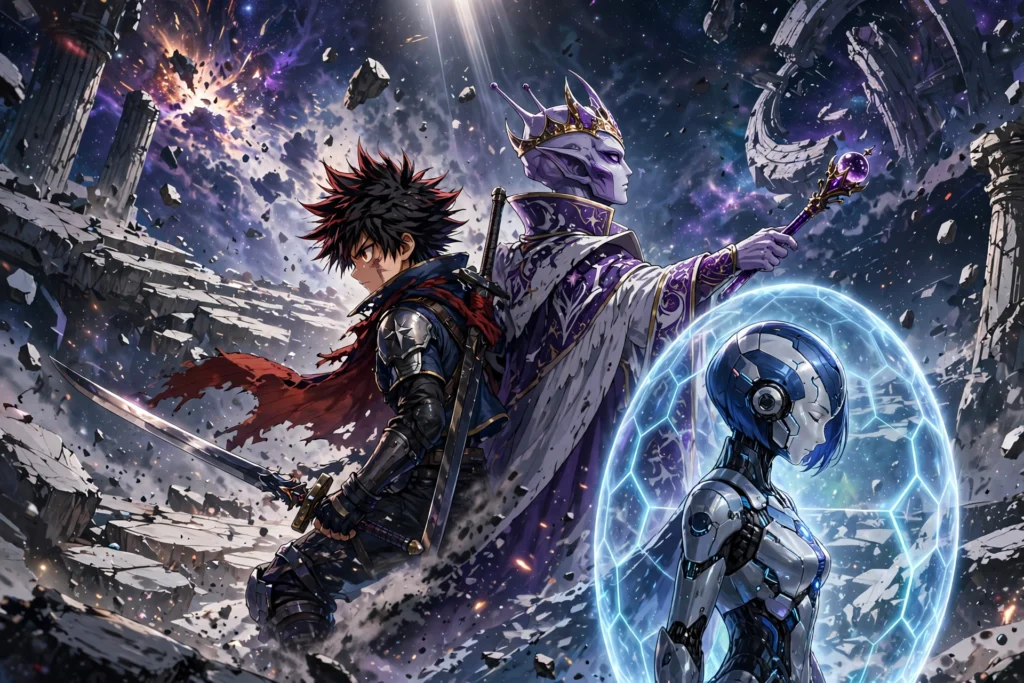
Dragon Ball is sold, most of the time, as a series of one-on-one duels: one hero, one villain, one sky to scream in. Its posters put a lone fighter in the middle and everyone else at the edges. Yet the story itself keeps being saved by something messier and better. Again and again, when a single fighter is not enough — and someone has to hold a tail, buy ten seconds, guard a doorway or fire from a wounded shoulder — teamwork is what rescues Dragon Ball from its own power scale. This is our dragon ball team ups ranked, and it is an argument that the series is at its best when its fighters stop performing alone.
A quick clarification, because this site also covers fusion: this is a different piece from our fusion rankings. Nothing here is a fusion. Every entry is about two or more fighters coordinating as themselves — separate bodies, separate wills, separate grudges — choosing, in real time, to trust each other. Teamwork is what happens in the space fusion deletes. A merged warrior cannot disagree, hesitate or sacrifice himself for his other half, because the other half is him. A team-mate can do all three, and on this list, the best ones do.
That friction is the point. Pride has to be swallowed. Old hatred has to be parked. A student has to trust a teacher’s gamble and a father has to trust a son he has barely spoken to. The eight team-ups below are ranked as partnerships, not power levels, and they count down to an alliance so unlikely that the series built an entire tournament to earn it.
How We Ranked Them
We scored every candidate on three tests. First, did it win? A beautiful combination that loses can still place, but a team-up that actually ended the fight, saved the planet or took the tournament earns its ranking the hard way. Second, what did it cost the characters to cooperate? Some of these pairings cost a fighter a technique, a tournament or his dignity. One costs a life. The harder cooperation was to give, the more the moment means. Third, how well is the teamwork itself written? We are not ranking the fighters, their forms or their power. We are ranking the coordination: who creates the opening, who takes the role nobody wants, and whether the plan could only have worked with these specific people in it.
Fusions are excluded by name and on purpose. Vegito, Gogeta, Gotenks and Kefla do not appear anywhere below, however strong they are, because a fusion is a new person, not a partnership. If you want them, read our ranking of every Dragon Ball fusion, ranked weakest to strongest — then come back here for the harder, human version of the same idea. Where the anime and the manga tell a team-up differently, we label which version we are ranking rather than blending them into one fight that never quite happened.
8. Androids 17 and 18 vs Universe 2 and the Tournament of Power Field
Some partnerships need speeches. The twins need a glance. Androids 17 and 18 fight the way siblings who grew up together do everything: with a shared rhythm nobody taught them and nobody else can hear. Across their Tournament of Power run in the anime, including their stand against Universe 2’s warriors, they cover each other’s blind sides, swap opponents without discussion and rescue each other in the middle of combinations other teams would need a week of practice to land. Their coordination was honed as villains in the Cell saga era, which is part of the pleasure here — the same cold synchrony that once terrified the heroes now protects them.
Nothing about their run is solemn, and that is its charm. While universes face erasure, 18 still finds time, in general terms, to talk about money and what a win should be worth, as if survival were a negotiation she intends to win twice. It is funny, and it is also character writing: her priorities keep the pair grounded while the tournament turns operatic around them. The stakes of their individual fights are simply lower than everything above this spot, and their teamwork, however fluent, never has to carry the fate of the story on its own. Ranked last for stakes, first for chemistry.
7. Goku and Hit vs Dyspo and Kunshi
Universe 7 and Universe 6 are supposed to be eliminating each other. Instead, for a few minutes of the Tournament of Power in the anime, the two smartest fighters of their respective teams behave like professionals who have read the same scouting report. Dyspo’s speed is the problem: he is fast enough to punish reactions, and his teammate Kunshi exists to rescue him and tangle up anyone who corners him. Goku and Hit solve it the way veterans solve things — they swap. Mid-fight, without a conference and barely a word, each takes the opponent whose style suits him, and a matchup that was strangling both of them comes apart. It is no accident that both men sit high in our ranking of Dragon Ball’s smartest fighters, ranked by fight IQ: this is intelligence expressed as trust.
What it cost them is the smallest price on this list, and that is also what caps it here. This is an alliance of convenience between rivals who fully expect to aim at each other later, and it solves a dangerous matchup without delivering an elimination of its own. But as pure teamwork — timing, role-swapping and professional respect between two fighters who owe each other nothing — almost nothing in the tournament is cleaner. Sometimes the most honest partnership in the series is two experts deciding, silently, that the man beside them is not the problem right now.
6. Vegeta and Future Trunks vs Goku Black and Zamasu
Vegeta spent most of Future Trunks’ life being a lesson in what emotional distance looks like, which is why this fight lands the way it does. In the anime version, father and son stand together against Goku Black and Zamasu and combine their Galick Guns into a single beam — a shared technique, fired as one, by a prince who once would not have shared a battlefield briefing with his own child. The attack matters, but the posture matters more: Vegeta does not shield Trunks from the fight or take it over. He fights beside him, as an equal, and the coldest father-son relationship in the series thaws in the middle of a war for a ruined timeline.
Label the versions honestly, because they differ. The manga tells this arc’s teamwork differently, giving Trunks a more supporting role — including healing duties — and spreading the paired offense out rather than building to the anime’s combined beam as the centrepiece. We rank the anime version here for that Galick Gun, while crediting the manga for making Trunks the lifeline his father never learned to be for anyone. Either way, the win is partial — Zamasu is not finished by this pair alone — but the relationship is permanently changed, and a team-up that heals its own team while it fights earns its place.
5. Goku and Gohan and the Father-Son Kamehameha vs Cell
Start with the objection, because this entry has heard it for thirty years: Goku is dead for this entire beam struggle, so how is it teamwork? He cannot throw a punch, take a hit or lend Gohan a functioning arm — and Gohan, fighting with one broken arm and a collapsing nerve, has to hold Cell’s Kamehameha back essentially alone. If teamwork requires two bodies on the field, this does not qualify, and we understand readers who would leave it off a list like this entirely.
Our answer is that this list honors the emotional kind of teamwork too, and no entry earns that argument better. Goku is present the only way he can be: as a voice in his son’s ear, coaching, calming and refusing to let the boy quit on himself, his spirit drawn alongside Gohan’s in the struggle’s defining image. The knowledge being shared is real teamwork cargo — when to hold, when to stop doubting, when to finally push — and it flows from the one person Gohan trusts completely, who has already given his life once in this same fight to buy his son a chance. It won. Cell ended in that beam. And the cost was already sitting on the table before it started: a father who could be a voice and nothing more. We count it, proudly, and we think the series does too.
4. Gohan and Piccolo vs Cell Max
Most team-ups on this list happen inside the fight. This one, from the Dragon Ball Super: Super Hero film, was won before the fight properly began, and that is exactly why it ranks this high. Piccolo understands something nobody else in Gohan’s life will say out loud: the scholar has let his edge go, and gentle reminders will not bring it back in time. So Piccolo gambles. In general terms, he arranges a staged kidnapping — Pan placed in apparent danger, playing her part in the deception — to put the one sight in front of Gohan that has always bypassed his excuses. It is manipulative, risky and completely in character for a teacher who has been dragging this boy’s potential out of him since childhood.
Inside the fight against Cell Max, the planning continues: Piccolo takes the punishment, grows into the problem and holds the monster in place long enough for the student to become what the gambit was designed to release. Then the circle closes, and we will state it precisely: Gohan’s Beast finisher echoes Piccolo’s technique visual language — the two-fingered charge at the forehead, the spiralling beam — because Gohan ends this fight with the Makankosappo, his teacher’s signature move, inherited across a lifetime. A technique Piccolo once developed to kill Goku is fired, a generation later, by Goku’s son, to save them all. That is teamwork of planning, inheritance and trust, not just punches, and it defeated Cell Max outright.
3. Goku and Piccolo vs Raditz
Here is where Dragon Ball teamwork was invented: a grabbed tail, a charged beam and a hold Goku never expected to survive. Strip away everything the series later became and look at what is actually on the field. Goku and Piccolo are mortal enemies. Piccolo has spent years preparing to kill the man standing next to him, and the technique he brings to this fight — the Makankosappo — was developed for exactly that purpose. Raditz is stronger than both of them put together. There is no form coming, no backup arriving and no plan that does not involve somebody accepting a terrible job.
The jobs get shared with desperate clarity. Goku uses Raditz’s tail as a weakness, loses the advantage to his own mercy when his brother talks his way free, and then makes the only remaining play: he locks Raditz in a full-body grip from behind — a suicide grip, chosen knowingly — and holds him there while his enemy charges the stolen-purpose technique long enough to fire it. Piccolo, to his credit, does not hesitate and does not miss. It won. Raditz died, Earth got its warning about the Saiyans still to come, and Dragon Ball’s heroic era started with two men who hated each other a week earlier performing desperation choreography nobody had ever seen in the series before. The price was the highest on this list until our number one: Goku’s life, paid in full, in the series’ first great team-up. Top three is not nostalgia. It is the foundation everything else here stands on.
2. Goku and Vegeta vs Jiren
Earlier in the Tournament of Power’s final stretch, before the alliance at number one became necessary, the series tried the partnership it had been teasing for decades: Goku and Vegeta, side by side, against an opponent neither could move alone. What makes it fascinating is that it is visibly unrehearsed. Whis observes, in general terms, that the two are not attacking as a polished unit — their rhythms do not match, because Goku and Vegeta have spent a lifetime taking turns, not sharing. And yet the pressure works, because Jiren has to solve two entirely different problems arriving at once, from two fighters stubborn enough to keep standing back up into each other’s patterns until something like synchrony emerges in real time.
This is the rivalry as a weapon, which is why we have written about that relationship from the other direction in our ranking of every major Dragon Ball rivalry, ranked. As a team-up, it ranks below the trio for one clean, unsentimental reason: it pressured Jiren without finishing him. It bent the strongest mortal in the tournament, forced respect out of him and kept Universe 7 alive — but it did not close. The pair’s pride also caps what they can be together; neither man will fully design a fight around the other while both are still standing tall. For that, the tournament needed a third man, a worse enemy and a much better plan.
1. Goku, Frieza and Android 17 vs Jiren
This is the anime framing of the Tournament of Power finale, and it is the thesis of the entire arc performed as a fight. The manga tells the tournament’s closing phase differently — in pacing, in how the final fighters are used and in the order of its closing beats — so we are ranking the anime’s version specifically: a hero running on fumes, his lifelong nemesis, and a deadpan android, executing the most coordinated final play in the history of the series. Look at the roles, because the roles are the argument. Android 17, the freshest legs left, becomes the support player: barriers thrown up to shield spent fighters, covering fire, positioning, the unglamorous work that keeps a plan alive. Goku, his strength nearly gone, stays in Jiren’s face because someone has to be the thing Jiren is watching.
And then Frieza — Frieza — makes the play of his life: a sacrifice-tackle, hurling himself at Jiren to drag them both toward the edge, trusting that Goku will add the last force needed and that 17 will be the one still standing when the dust settles. Every part of it cost somebody something real. It cost Frieza his dignity: the emperor of the universe, reduced to a grappling, screaming team player for the monkey he hates. It cost Goku the last of his strength. It cost 17 the spotlight, which he never wanted. And it won — the tournament, the survival of Universe 7 and, through 17’s wish, the restoration of everyone else. Three fighters who, between them, had tried to kill each other in three different decades, won the biggest prize in the series by trusting a plan none of them could have survived alone. That is not just the best team-up in Dragon Ball. It is the point of Dragon Ball, stated in one fight.
Summary: Every Team-Up at a Glance
| Rank | Team-up | Opponent | What the teamwork proved |
|---|---|---|---|
| 8 | Androids 17 and 18 | Universe 2’s warriors and the Tournament of Power field | Wordless sibling synchrony can survive a tournament, even if it cannot headline one. |
| 7 | Goku and Hit | Dyspo and Kunshi | Professional respect and a mid-fight opponent swap beat a bad matchup. |
| 6 | Vegeta and Future Trunks | Goku Black and Zamasu | A shared beam can help heal the coldest father-son bond in the series. |
| 5 | Goku and Gohan | Cell | Teamwork can be emotional: a father’s voice can hold a son’s nerve, and his beam, together. |
| 4 | Gohan and Piccolo | Cell Max | The best teamwork starts before the fight, in a teacher’s plan and an inherited technique. |
| 3 | Goku and Piccolo | Raditz | Dragon Ball teamwork was born from enemies, desperation and a price paid in full. |
| 2 | Goku and Vegeta | Jiren | Even unmatched rhythms create a pressure no single fighter can sustain. |
| 1 | Goku, Frieza and Android 17 | Jiren | Trust between enemies won a tournament and saved every universe in it. |
The Team-Up the Series Still Needs
For all the partnerships above, one obvious pairing has never been given its fight: Vegeta and Piccolo. Consider what they are. The two great reformed villains of the Z era, the men who arrived as planet-level threats and stayed to become fathers, mentors and defenders. They have shared a battlefield for decades without ever being given a battle that belongs to both of them. They fight in the same wars, stand in the same group shots and exchange the same terse nods — and then the story sends Vegeta toward Goku’s orbit and Piccolo toward Gohan’s, every single time.
On paper, they are the most complementary pair the series owns. Piccolo is its best battlefield planner among the heroes: patient, sacrificial, happy to win ugly. Vegeta is its proudest finisher: the fighter who turns a half-opening into an execution. A real two-man fight would force both out of their habits — Piccolo having to trust a partner who will not follow a careful plan for long, Vegeta having to fight inside someone else’s design instead of rewriting it by force. Two reformed villains, each carrying a past the other understands better than anyone, finally proving their redemption together instead of in parallel: that is the team-up Dragon Ball still owes us, and on the evidence of this list, it would rank very high indeed.
Frequently Asked Questions
Why are fusions not on this list?
Because a fusion is not a team-up. Vegito, Gogeta, Gotenks and Kefla are single, merged warriors, so there is no cooperation, disagreement or trust to rank. This article only covers two or more fighters coordinating as themselves, which is why fusions are excluded by name in our criteria.
What is the greatest Dragon Ball team-up ever?
By our three tests — did it win, what did cooperation cost, and how well the teamwork is written — it is Goku, Frieza and Android 17 against Jiren in the anime’s Tournament of Power finale. It won the tournament, it cost Frieza his dignity and Goku his remaining strength, and every fighter’s role in the final play was essential.
Did Goku and Piccolo really beat Raditz if Goku died?
Yes, and the death is part of why it ranks third rather than lower. Their plan worked: Raditz was killed and Earth was warned about the Saiyans to come. But the win cost Goku his life, which is the clearest possible evidence of what their cooperation demanded from both men.
Is the Father-Son Kamehameha really teamwork?
We argue yes — the emotional kind. Goku could not fight beside Gohan physically, so he coached him through the beam struggle as a voice and a presence, supplying the calm and timing his son could not find alone. This list honors that kind of teamwork, while admitting in the entry itself why some readers would not count it.
How do the anime and manga versions of these team-ups differ?
In the details, and we label them in each entry. The anime builds Vegeta and Future Trunks’ fight around a combined Galick Gun where the manga gives Trunks a more supporting role, and the Tournament of Power’s closing phase — including our number one — plays out differently in the manga’s pacing and use of its final fighters.
Which team-up should Dragon Ball do next?
Vegeta and Piccolo. The series’ two reformed villains have fought in the same wars for decades without ever headlining a two-man fight together, and their styles — Piccolo’s planning and Vegeta’s finishing — fit better than almost any untried pairing in the series.



Pingback: Dragon Ball Saga Finales, Ranked